POV: You Chose the Soft Life — But It's Running on Debt
Summary
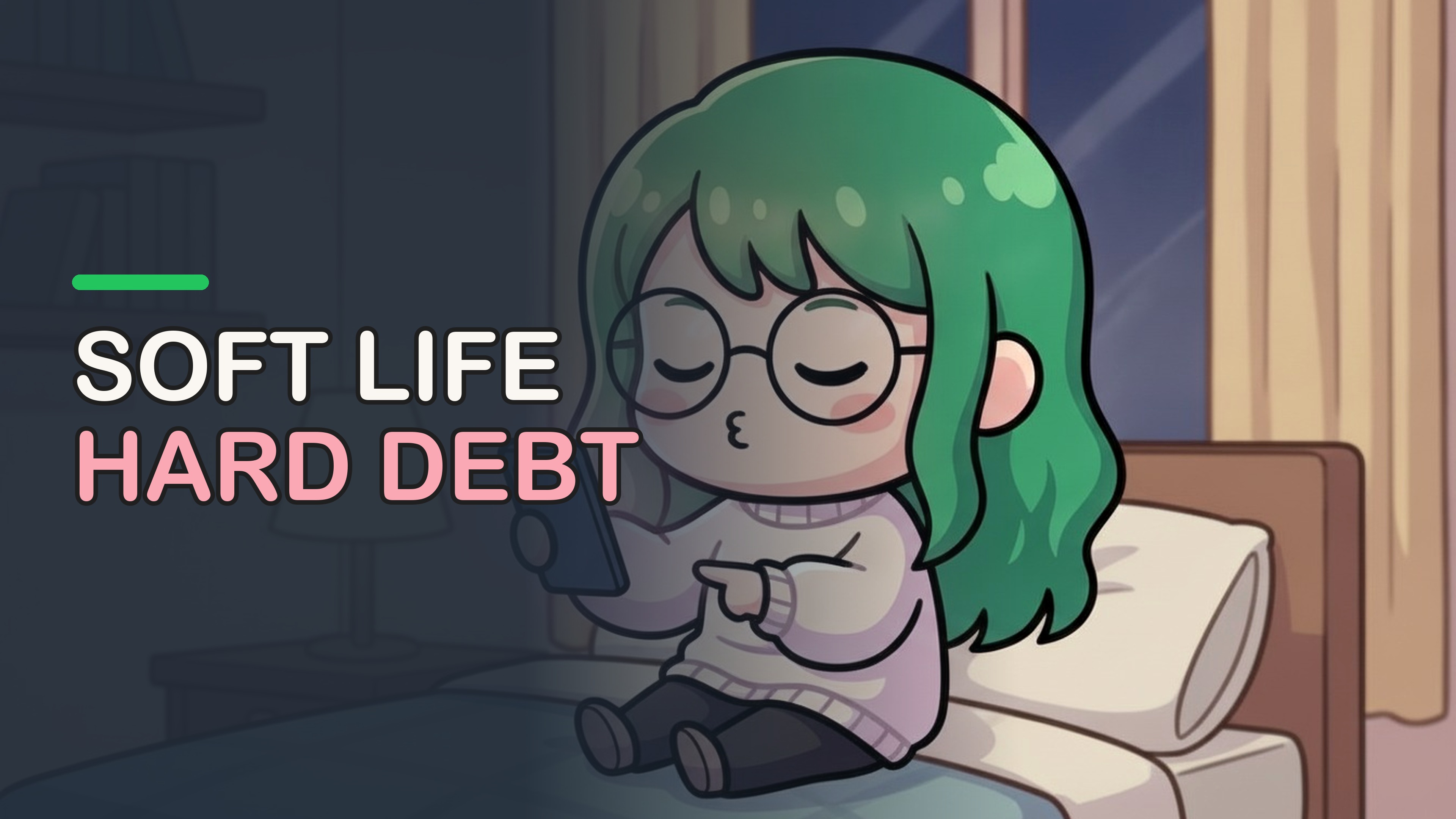
It is eleven at night, and your thumb is hovering over the buy button. In the cart, a matcha set, linen sheets, a month at the reformer Pilates studio that just opened near you.
The soft life promised rest, ease, and freedom from constant struggle. When the feeling is financed, the future gets the hard version of every peaceful purchase.
Transcript
Read the full transcript
It is eleven at night, and your thumb is hovering over the buy button. In the cart, a matcha set, linen sheets, a month at the reformer Pilates studio that just opened near you. A whole calmer life, and none of it paid for yet. You are not being reckless. You are, in fact, being very responsible. You are investing in your peace. You are romanticizing your life. You are choosing softness, because you have earned a little softness, haven't you. So you tap the button, and for about four seconds, you feel calm.
Here is the thing nobody says out loud. You are not buying linen. You are buying the feeling of being the kind of woman whose life is already calm. You are buying a version of yourself who is rested, and cared for, and slightly ahead. And you are buying her on a card, before the income that would make her real has actually shown up. When the calm wears off, the balance is still there. So you do it again.
If you have ever called yourself spoiled, or materialistic, or just bad with money while your cart quietly refilled, stay with me. This is not a discipline problem. It is a loop. It has a name, it has a price, and by the end of this video you will know exactly how to keep the soft life and stop letting it run on debt.
Let's take the shame out first, because you cannot fix a loop you are busy hating yourself for. The soft life is not a random weakness. It is the most well-designed sales funnel of your generation. Here is the trick at the center of it. Ordinary spending feels a little guilty, so your brain resists it. But the moment a purchase gets relabeled as wellness, as self-care, as investing in yourself, the guilt disappears, and you spend more.
Psychologists have a name for this. It is called self-licensing. In one classic study, people who first did something virtuous were more than twice as likely to then choose a luxury over the thing they actually needed. Being good gave them permission to spend. Now wrap an entire wellness industry around that permission, nearly five hundred billion dollars a year in this country alone, and you get the soft life. The generation buying the most of it is yours.
And there is a reason it works on you specifically. Retail therapy is real. When you feel low, buying a small treat genuinely restores a flash of control over a day that felt out of your hands. So the problem is not that you are weak. The problem is that the calmest, most cared-for feeling in your week has become something you have to purchase, on repeat, from people who profit every time you feel behind. You are not broken. The loop is just very, very expensive.
So let's name the ways the soft life quietly bills you. See how many you recognize.
Number one. The self-care override. This is the sentence that ends every budget. It's not shopping, it's self-care. The candle, the supplements, the spa day, the third matcha of the week. Each one gets waved through because it is technically wellness, and wellness feels responsible. Individually, none of them feel like a decision. Together, they are the decision, and they all land on the same card, one guilt-free swipe at a time. And the tiring part is the little argument you have with yourself at every checkout, dressing a want up as a need until you genuinely cannot tell the difference anymore.
Number two. The aesthetic, on four easy payments. This is where the soft life meets buy now, pay later. That six-hundred-dollar espresso machine is not six hundred dollars anymore. It is four payments of a hundred and fifty, which barely registers as a price at all. That is not an accident. When researchers looked at ninety-five thousand real purchases, the pay-later ones were about sixty-three percent bigger, because the small number switches off the part of your brain that flinches. And it adds up in a way you can measure. Studies tracking millions of people found that pay-later users paid around a hundred and seventy-six dollars more a year in overdrafts and fees, and the people who could least afford it paid the most. And this is not a frivolous-girl problem. Women and people on lower incomes are more likely than average to use it, the exact people the soft life is aimed at. Here is the part nobody mentions. Now you are tracking four payment dates across three different apps, and every couple of weeks another small one lands, and you cannot quite remember which purchase it was even for. Splitting the softness into four does not make it cheaper. It just makes it quieter, and a lot harder to see.
Number three. Subscription softness. The meditation app, the Pilates membership, the meal kits, the two streaming services you keep for background noise while you clean. Each one felt like buying a calmer life. Here is the gap. When people are asked to guess what they spend on subscriptions each month, they say about eighty-six dollars. When they actually add it up, it is two hundred and nineteen. More than forty percent are still paying for something they already stopped using. And a part of you knows. You have thought I should really cancel some of these at least a dozen times, and deferred it every single time, because auditing your own softness feels a little like admitting you got talked into it. It is softness on autopay, leaving your account whether you feel it or not.
Number four. Buying the props to prove the peace. Somewhere along the way, the soft life stopped being something you feel and started being something you show. So you buy the matching jars, the specific water bottle, the flowers for the shelf behind you, because a calm life apparently needs to be documented. And the feed you are documenting it for is the same feed that makes you feel behind. In one study, three minutes looking at an idealized profile measurably lowered people's self-esteem. Three minutes. So the machine sells you the wound and the bandage in the same scroll. Here is the life you don't have, and here, conveniently, is the checkout link.
Number five. Outsourcing everything to protect your energy. The delivery, the cleaner, the car instead of the train, the little upgrade that means you never have to be uncomfortable. And some of that is genuinely worth it. But your brain adapts fast. Last year's treat becomes this year's baseline, and the baseline never feels soft, it just feels normal, so you reach for the next upgrade to get the feeling back. You are not buying rest anymore. You are buying the absence of friction, at a price that quietly climbs every single month.
Number six, and this is the big one. Cutting the income to buy the calm. The soft life has a final boss, and it is the dream of working less. Of quitting the job that drains you, of a slower, softer schedule. That dream is not wrong. But look at the ground it is standing on. Only about sixty-three percent of adults could cover a surprise four-hundred-dollar bill with cash. Barely half have three months of expenses saved, and women are slightly behind men on that number. Not because of discipline, but because the soft life was marketed to us the hardest. Softness without savings is not freedom. It is dependence with better lighting, the kind where you check the balance before every little soft purchase and feel the room get smaller.
And here is the part that actually hurts. The soft life bought on debt manufactures the exact hardness it promised to save you from. You spent to feel calm, and now the balance is the thing you think about at two in the morning. You bought the aesthetic of a life with no stress, using the one tool guaranteed to add stress. The softness is rented. The debt is yours. And here is the cruelest part. The whole point of a soft life was to feel free. Free to rest, free to say no, free to leave a job or a person or a place that is costing you too much. But every payment you signed up for quietly takes a little of that freedom back. A life that looks soft on the outside can leave you with no room to breathe on the inside. You were never trying to be irresponsible. You were trying to feel safe. You just handed the bill for that feeling to a version of yourself who hasn't been paid yet.
So here is how you keep the soft life and take it off the credit line. You build a soft-life floor.
One. Fund the calm first. Before a single aesthetic purchase, set up an automatic transfer into savings the moment your pay lands, even a small one. There is a famous study where people who agreed to automatically save more out of every future raise went from saving three and a half percent to almost fourteen percent, without ever feeling a cut, because the money moved before they could spend it. Real softness is a number in an account that means you can breathe. Fund her first.
Two. Put the aesthetic on cash flow only. If the soft-life purchase is not in this month's actual money, it waits. No installments on candles. When something offers you four easy payments, do the math out loud. Four times a hundred and fifty is six hundred dollars, today. Say the real number before you decide.
Three. Give every self-care purchase twenty-four hours, and while it waits, call it what it is. Not self-care. A want. The whole trick is getting you to buy before that word catches up. If it is truly going to restore your life, it will survive one night in the cart. Most of it won't.
Four. Once a month, actually add up your subscriptions, all of them, and cancel anything you did not consciously choose this week. Cap the soft ones.
Five. Mute the accounts that make you feel behind. Not forever. Just enough that your next calm purchase is your idea, and not an ad's.
Six. Separate the practice from the props. The slow morning is free. The ritual is free. The forty dollars of matching ceramics is optional. Keep the ritual. Skip the receipt.
And seven. Every so often, take the train, carry the bag, cook the thing yourself. Not as punishment, but as a reset, so normal stops climbing and softness stays something you can actually feel again.
None of this asks you to give up softness. It asks you to own it, instead of financing it.
Because you were never the problem. You are a smart, tired woman being sold your own exhaustion at a markup, and noticing the loop is how you step out of it.
So tell me. Which trap was yours? The self-care override. The four-easy-payments aesthetic. The subscriptions you forgot you were feeding. Or the quiet dream of cutting your income before you built the floor. Put the one that stung in the comments, and if you are brave, the exact thing sitting in your cart right now. I read them, and you are not the only one who felt a little seen just now.
And if a name popped into your head while you watched, someone whose whole feed is soft and whose group chat is stressed about money, send this to her. Not to call her out. To hand her the floor plan. The soft life was always supposed to be yours. Let's make it something you own, and not something you owe.
Sources & further reading
These are the research sources reviewed for this episode. Evidence and guidance can change; updated entries show a new date above.
- Prelec & Loewenstein (1998), Marketing Science — pain of paying / coupling— pubsonline.informs.org
- Soman (2003), Marketing Letters — payment transparency— www-2.rotman.utoronto.ca
- O'Donoghue & Rabin (1999), AER — present bias— cpb-us-e1.wpmucdn.com
- Ashby, Sharifi, Yao & Ang (2025), J. Retailing — BNPL spending / installment numerosity— sciencedirect.com
- deHaan, Kim, Lourie & Zhu (2024), Management Science — BNPL overborrowing ($176–$252/yr)— pubsonline.informs.org
- Khan & Dhar (2006), J. Marketing Research — self-licensing— w4.stern.nyu.edu
- Atalay & Meloy (2011), Psychology & Marketing — retail therapy— onlinelibrary.wiley.com
- Rick, Pereira & Burson (2014), J. Consumer Psychology — shopping restores control— myscp.onlinelibrary.wiley.com
- Vogel et al. (2014) — social comparison & self-esteem— researchgate.net
- Verduyn et al. (2017) — highlight-reel → upward comparison— ppw.kuleuven.be
- CFPB (2023) — BNPL borrower profiles / demographics— consumerfinance.gov
- Thaler & Benartzi (2004), "Save More Tomorrow"— besci.org
- Ashraf, Karlan & Yin, "Tying Odysseus to the Mast" — commitment savings— navaashraf.com
- LendingTree (2026) — BNPL late-payment trend— lendingtree.com
- C+R Research / CNBC (2022) — subscription underestimation ($86 est. vs $219 actual)— cnbc.com
- Federal Reserve, SHED 2024 — $400 emergency / emergency-fund data— federalreserve.gov
- McKinsey, Future of Wellness (2024) — US $480B wellness market— mckinsey.com
- "Soft life" origin (Nigerian communities, ~2020)— calm.com
- "That Girl" trend origin & criticism— en.wikipedia.org
- "Lucky girl syndrome"— theconversation.com
More in Debt & Credit
Start with your own patterns
The free Money Pattern Lab turns seven ordinary days into one clearer picture of your spending triggers.
Your PDF opens immediately. Confirm your email for the free welcome series and weekly letter. Unsubscribe whenever.