POV: Every Time the News Gets Scary, You Buy Something
Summary
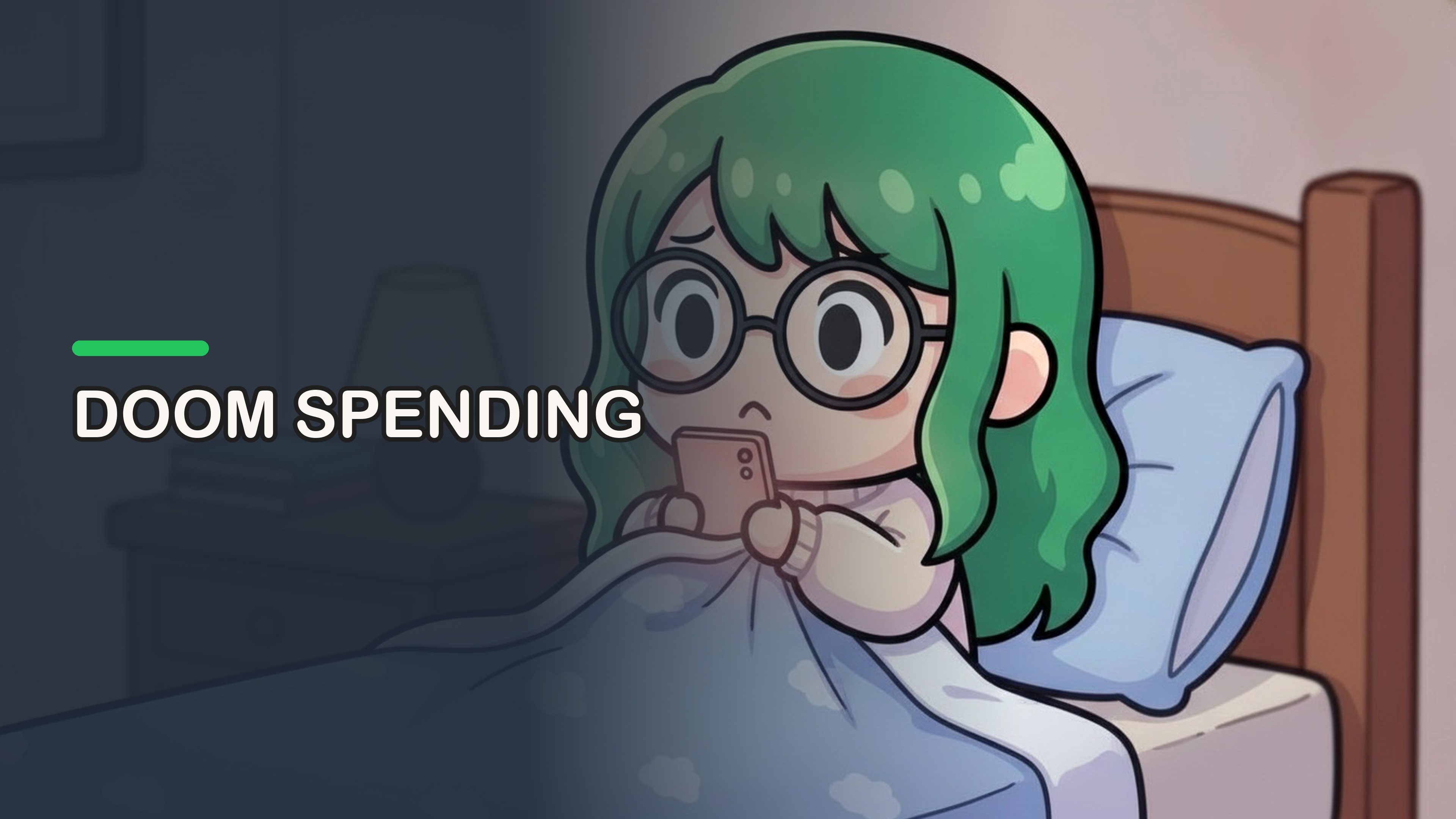
It's late. You're lying in bed with your thumb moving on its own, and the feed is nothing but bad news.
The headline makes the future feel uncontrollable, so a delivery confirmation offers one small event you can control. Doom spending is immediate relief purchased during uncertainty, with tomorrow left to absorb it.
Transcript
Read the full transcript
It's late. You're lying in bed with your thumb moving on its own, and the feed is nothing but bad news. Layoffs at a company you don't even work for. Rent going up again. Another headline about a world one notch closer to falling apart. And somewhere in the middle of all that dread, without really deciding to, you open another app. Not the news one. The one with the cart. And you buy something. Something small, usually. A little treat. A thing you'll feel for about an hour.
It doesn't feel like shopping. It feels like doing something while everything else spins. Like pressing one button that actually does what you told it to.
You've heard the word for the first behavior. Doom scrolling. But there's a second one that quietly follows it around, and it has a name too. Doom spending. And if you're the kind of person who gets a little poorer every time the world gets a little scarier, this video is about the exact loop you're in.
Because here's the part nobody tells you. That purchase isn't random, and it isn't proof that you're bad with money. It's your brain trying to solve a feeling with a transaction. And by the end of this, you'll know why it feels so rational in the moment, what it's quietly costing you, and the one system that breaks it.
So let's take the shame off the table first, because you're going to need it gone to see this clearly.
When the future feels uncertain, your brain doesn't experience that as an interesting economic debate. It experiences it as a threat. And a threatened brain wants one thing more than almost anything else. Control. It wants to feel like it can still choose an outcome, still make something happen, still steer.
Here's what's wild. Researchers studied something very close to this, and they found that the part of shopping that actually makes you feel better isn't owning the item. It's making the choice. In their experiments, even imagining a purchase, choosing between options they would never actually buy, was enough to lower people's sadness. The relief came from deciding, not from spending. Your brain is buying a feeling of agency, and the product is just the receipt.
That's why it works, a little, every time. The purchase gives you a small hit of control and a small hit of dopamine right when you feel powerless. That's not weakness. That's a nervous system doing its job.
The problem isn't that your brain reaches for relief. The problem is the tool it grabs. Because the thing you buy to feel safe is quietly making you less safe. And to see how, you have to catch the loop in the act.
So here are the signs. Not to make you feel caught. To make the loop visible, because you can't interrupt something you can't see.
Number one. Your spending follows the headlines, not your life. Notice when you buy. It's usually not payday. It's after the scary article, the group chat full of bad news, the two hours of scrolling. Analysts have a name for this now. Vibe-based budgeting. Your money is being steered by how the economy feels, not by what your month actually needs. So your money leaks on a schedule set by strangers writing headlines. And you can't even enjoy the thing, because you bought it while anxious and you're already bracing for the next headline.
Number two. You panic buy things you never actually use. When the world feels shaky, stocking up feels smart. So you buy the backup, the bulk order, the just in case. More than four in ten Gen Z adults say they panic buy over fear of price hikes or shortages. Some of it is groceries. A lot of it is comfort dressed up as preparation. And you end up with a cabinet full of money you turned into stuff you're not using, a pile that was supposed to feel like security and somehow just feels like more to manage.
Number three. The buying is frictionless, so the fear becomes an order before it passes. This is the dangerous one. You feel the spike, and there's a button that turns it into a package before the feeling even fades. Pay in four. One tap. No card, no pause, no moment where it feels real. And that gap is exactly where the damage happens. Nearly half of the people using buy now, pay later have paid late in the past year. Gen Z regrets it the most and plans for it the least. So you get late fees and four little payments stalking your next paycheck, and you start to flinch every time you open your banking app.
Number four. The relief has a shorter and shorter shelf life. Remember the first doom purchase that actually helped. It doesn't hit like that anymore. That's not in your head. Your brain adapts to the reward, so the same buy delivers less calm each time. So the treat gets a little bigger, a little more often, chasing the same hour of okay. Your spending quietly escalates. You're doing mental math to justify a treat that used to justify itself. A coping tool that used to be cheap is now on a subscription plan you never signed up for.
Number five. No matter what you earn, the emergency fund never moves. Here's the one that stings. You could get a raise and still watch your savings sit flat, because every time you get ahead, a scary week eats the margin. Thirty-seven percent of Americans couldn't cover a surprise four hundred dollar expense with cash. And if you're in this loop, it's not because four hundred dollars is impossible. It's because the buffer keeps getting spent the second the world feels uncertain. So you stay one bad week away from a crisis, and you feel it every single time your phone buzzes with a bill.
Number six. You stopped saving on purpose, because the future feels fake. This is doom spending's final form. Somewhere along the way, a quiet thought moved in. Why save if it's all going to fall apart anyway. If the future is doomed, spending now at least feels like getting something back. Psychologists call this present bias with the volume turned all the way up. And you've talked yourself out of the one behavior that would make the future less scary. That's the worst tax of all. Not the money. The moment when staying broke started to feel like being realistic.
Now put it all together, because this is the part that matters.
You are spending money to feel safe from an uncertain future. And the spending is the thing making your future uncertain.
Sit with that for a second, because it's not a joke and it's not your fault. The purchase gives you control for an hour. But it comes straight out of the buffer. The savings. The cushion. The exact thing that would let you look at a scary headline and think, I'd be okay. So the cushion gets thinner. And a thinner cushion means the next piece of bad news lands harder, because now it actually could hurt you. Which means more fear. Which means more doom spending.
That's the trap. It's a loop that feeds itself. You're not failing at the loop. The loop is working exactly as designed. You're trying to buy your way out of anxiety using the one currency that anxiety runs on.
And the good news is hidden right in there. If the spending is what keeps you fragile, then the fix isn't about becoming a calmer person or willing yourself to stop caring about the news. It's about changing one mechanical thing before the fear ever reaches the checkout.
So here's the system. Not discipline. Not a vibe. A structure that works on your worst night, when you're anxious and tired and you don't want to be good.
Start with the one move that does the most. Automate your safety so it doesn't depend on your mood. Pick a small amount, one you'd barely notice, and set it to move itself into savings the day your money lands, before you can talk yourself out of it. This isn't willpower. Willpower is exactly what you don't have at eleven at night after the news. Researchers built a whole program around this idea, letting people pre-commit to saving automatically. People who could barely save went from about three and a half percent of their paychecks to almost fourteen percent, mostly because they never had to decide again. Call yours the anti-doom fund. It's the buffer that quietly makes the headlines less scary while you sleep.
Second. Put a wall between the fear and the checkout. A twenty-four hour rule. When the urge to doom buy hits, you don't say no. You just say not yet. Write the thing down on a list you actually keep, and let a day pass. Because most impulse urges are gone within twenty-four hours. Roughly seventy percent of them just evaporate on their own. You're not banning the purchase. You're outlasting the feeling that demanded it. Half your list will look ridiculous by tomorrow afternoon.
Third, and this is the clever one. Give your brain the control without the charge. Remember that the relief was never about the money. It was about making a choice, feeling a flash of control. So when the panic hits, do one small thing you actually decide and finish. Take the walk. Text back the friend you've been meaning to answer. Close the app and clean one surface. Cancel one subscription you forgot about, which, funny enough, is a spending decision that pays you back. You're feeding the real craving, which was never the product. It was agency.
And last, turn down the trigger. You don't have to become uninformed. But the doom feed is the on ramp, so add a little friction there too. Mute the accounts that spike you. Take the saved cards out of your phone. Delete the one tap app. Make the scary and the spending a little harder to do back to back. They were only ever a problem when they were one smooth motion.
So here's what I want you to take with you.
Doom spending isn't proof that you're irresponsible. It's proof that you're a person who feels things, living through a genuinely uncertain time, holding a phone designed to turn that feeling into a transaction in under ten seconds. The behavior makes sense. It's just expensive, and it's aimed at the wrong target.
The next time the news gets scary and your thumb drifts toward the cart, try asking one question. What is this actually protecting me from. And then, what is it costing the buffer that would actually protect me. That pause, that single question, is the whole loop breaking in real time.
So tell me. What's the purchase your brain reaches for when the world feels like too much? Is it the comfort haul, the little treat, the just in case? Put it in the comments, because naming it is how you take its power back.
And if someone you love panic buys every time the headlines break, send them this. Not as a callout. As a way out.
Sources & further reading
These are the research sources reviewed for this episode. Evidence and guidance can change; updated entries show a new date above.
- Young Americans doom spend to cope with stress— creditkarma.com
- Forget doom scrolling, Americans now doom spend— creditkarma.com
- Vibe-based budgeting— creditkarma.com
- 27% of Americans are 'Doom Spending' — Psychology Today— psychologytoday.com
- Overcoming Financial Anxiety and Doom Spending — Psychology Today— psychologytoday.com
- Doom spending as Gen Z/millennial coping — PAD Therapy NYC— padtherapyny.com
- What Is Doom Spending? — SoFi— sofi.com
- U. Michigan writeup— news.umich.edu
- ScienceDirect (Rick, Pereira & Burson)— sciencedirect.com
- Thaler & Benartzi, Journal of Political Economy— journals.uchicago.edu
- Commitment device — Wikipedia— en.wikipedia.org
- Digital Journal— digitaljournal.com
- SpendTrak science-backed guide— spendtrak.app
- LendingTree BNPL statistics— lendingtree.com
- Motley Fool 2025 BNPL study— fool.com
- Federal Reserve SHED — unexpected expenses— federalreserve.gov
- Fed SHED — Savings & Investments 2025— federalreserve.gov
- Penny Hoarder 2026 Financial Anxiety Barometer— thepennyhoarder.com
- Sun Life 2026 Financial Stress Survey— sunlife.ca
- Women budgeting harder in 2026 — The Queen Zone— thequeenzone.com
More in Spending Psychology
Start with your own patterns
The free Money Pattern Lab turns seven ordinary days into one clearer picture of your spending triggers.
Your PDF opens immediately. Confirm your email for the free welcome series and weekly letter. Unsubscribe whenever.