POV: "Girl Math" Is Quietly Keeping You Broke
Summary
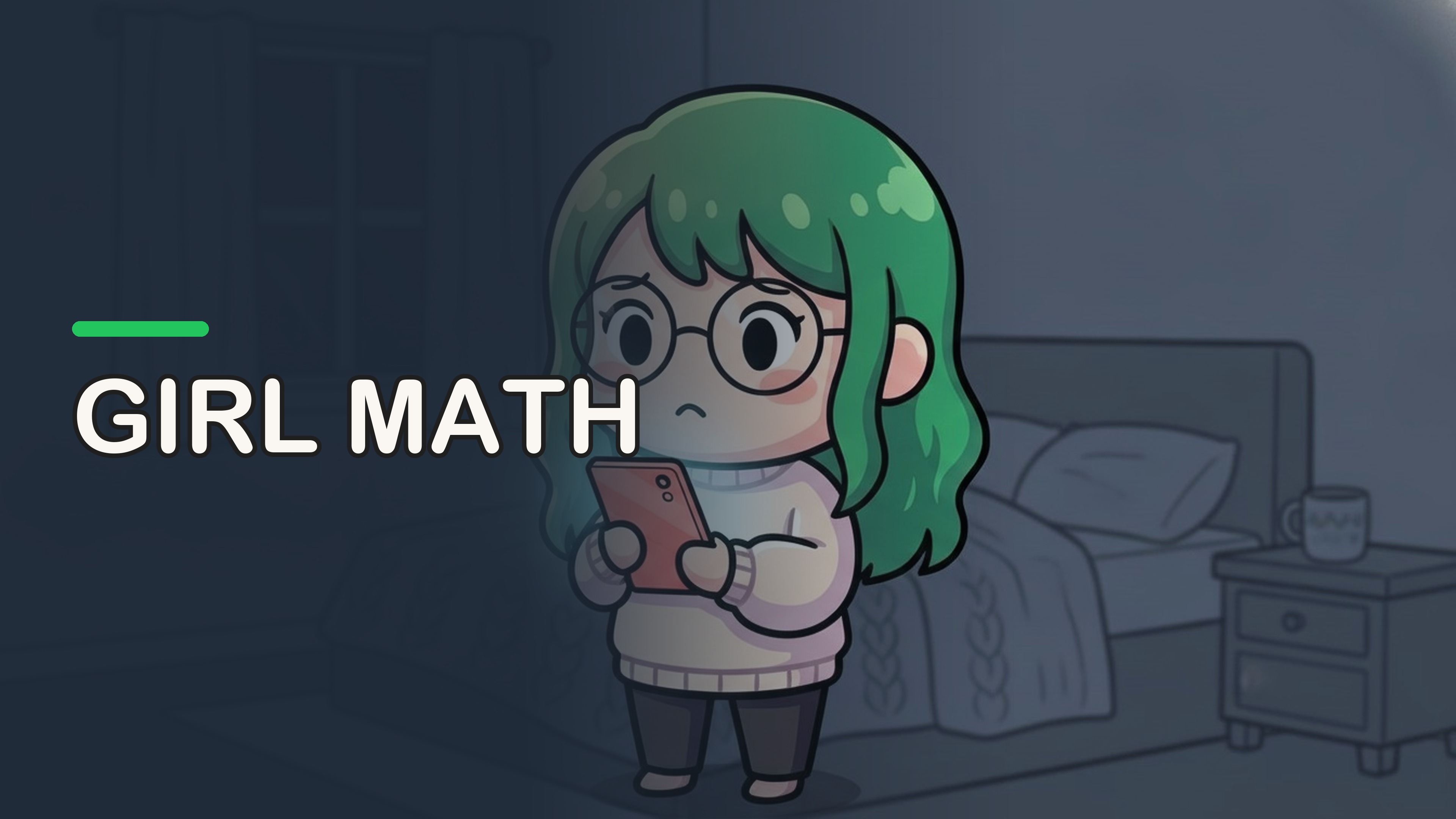
You are standing at the register, or your thumb is hovering over the place order button, and you hear yourself do the little voice.
That purchase was not basically free because you returned something last week. This is how playful mental accounting turns real spending into numbers your brain barely registers.
Transcript
Read the full transcript
You are standing at the register, or your thumb is hovering over the place order button, and you hear yourself do the little voice.
It is basically free. I paid with cash. It was on sale, so I actually saved money. It is under five dollars, that does not even count. I returned something last week, so this is basically free money.
It is a joke. That is the whole point. It is funny because it is a tiny bit true, and because everyone you know does it too. It even has a name now. Girl math.
And girl math is genuinely funny. But somewhere underneath the bit, there is a quieter feeling. You open your banking app a few days later, and the number is lower than the story you told yourself. So you reach for the usual labels. I am just bad with money. I am irresponsible. I am frivolous. I cannot believe I did this again.
So here is what I want to do in the next few minutes. I am not going to take the joke away from you. The joke is great. But I am going to show you what the joke is quietly doing underneath. Because girl math is not proof that you are bad with money. It is proof that your brain is running a very normal, very human program that the checkout page was built to take advantage of.
Let me name it, then price it.
Here is the first thing you need to hear. You are not bad at math.
What you are doing has an actual name in behavioral economics. It is called mental accounting. Your brain does not treat all money the same. It sorts money into little buckets, depending on where it came from and how you pay for it. Cash in your hand feels different from a tap. A refund feels different from your paycheck. Five dollars feels different from fifty, even when it is the same fifty in ten little pieces.
None of that is a girl problem. Men do the exact same thing. They just never made a cute meme about it, so nobody calls it boy math and puts it on a mug. This is a human brain doing human brain things.
And the reason it costs you is not the meme. It is what the meme is sitting on top of. Every checkout you touch has been carefully designed to remove the little sting you are supposed to feel when you spend money. One tap. Saved cards. Split it into four. Free returns. The sale that was never really a sale.
As the writer Tori Dunlap points out, the purchase we call frivolous is almost always the feminine one. The latte. The manicure. Never the golf clubs. Never the season tickets. You are not worse with money. You are just marketed to more precisely.
So let me walk you through the actual girl math, one line at a time, and show you what each one quietly costs.
Rule one. If I pay with cash, it is basically free.
Here is what is really happening. Handing over physical cash is supposed to hurt a little. That tiny sting is not a bug. It is your brake. In one well known experiment, people were willing to pay up to twice as much for the exact same item when they used a card instead of cash. Same item. Double the price. The only thing that changed was how much the payment hurt. So when you tell yourself cash does not count, you have it exactly backwards. Cash is the most honest money you have. The tap is the one that lies.
Rule two. It was on sale, so I saved money.
Your brain gets two separate hits of pleasure when you buy something. One is getting the thing. The other is getting the deal. That second hit fires whether or not you even wanted the item. It is why a big red forty percent off sign can make you buy something you would never pay full price for. But saving forty percent on something you did not need is still spending sixty percent you did not have to. The word saved is doing a lot of quiet work there. You did not save anything. You spent, with a discount attached.
Rule three. Anything under five dollars is free.
There is a real study on this. People handed a single dollar bill tended to keep it. People handed the same dollar in four quarters spent it far more easily. Sixty three percent of the coin group bought candy, versus twenty six percent of the bill group. Small money does not feel like real money, so you never bother to guard it. But small money adds up in a straight line. A five dollar thing you buy every day, the one that does not count, is about eighteen hundred dollars a year. And if you invested that money instead, in thirty years it is almost two hundred thousand dollars. From the purchase that did not count.
Rule four. I returned something, so this is free money. Or, it was on a gift card, so it does not count.
A refund is not income. It is your own money coming back to you. A gift card is money that was already spent. But your brain files both of them in the fun bucket, and spends them two or three times faster than it would spend your paycheck. It feels like a windfall. It is just you, paying yourself back, and then buying something anyway.
Rule five. I will just split it into four.
Buy now, pay later feels like a hack. You get the thing, and the price shrinks into four friendly little payments. But splitting the cost is designed to do one thing. It hides the total, so you buy more. Orders placed with buy now, pay later run about eighteen percent bigger on average. The four payments are not the discount. They are the reason the cart got bigger.
Rule six. It is twenty nine ninety nine, so it is basically twenty dollars. And its cousin, I added a little more to get free shipping, so I saved.
Prices that end in ninety nine are a trick you fall for every time. You read left to right, you anchor on the first number, and twenty nine ninety nine quietly becomes twenty something instead of basically thirty. And the free shipping line is even better. You will happily add thirty dollars of things you did not want, just to avoid a six dollar shipping fee, because losing the six dollars feels worse than spending the thirty. The threshold was placed exactly there for that reason.
Rule seven. I will start saving next month. I deserve this right now.
This is the one that wears the nicest outfit, because it sounds like self care. But your brain heavily discounts anything that is not happening right now. Future you is abstract. The treat is real, and it is already in your hand. And there is a second move hiding inside it. After any good behavior, a decent week, one purchase you resisted, your brain feels like it earned a reward and switches the guilt off. I have been so good. I deserve it. That sentence is a blank check, and you are the one who has to cash it.
Now here is the part that actually matters. The part that is not a joke.
The reason girl math works so well is not that the individual lines are so clever. It is that the joke does something to you emotionally. When you spend money you probably should not have, you are supposed to feel a small flare of discomfort. That flare is useful. It is the thing that would make you pause next time.
Girl math takes that flare and turns it into a punchline. You say it out loud, your friends laugh, everyone agrees money is not real anyway, and the discomfort just dissolves. You get relief and you get belonging, both at once, and the one quiet signal that was trying to protect you is gone.
The financial psychologist Brad Klontz put it simply. Girl math, he says, is just the latest way we rationalize behavior we already know we should not be doing. And his tell, the question that gives it away, is this. Why do you need to justify it at all? Usually, because somewhere you already know you cannot quite afford it.
So the funniest, most relatable thing you say about being broke can quietly be one of the reasons you stay broke. Not because you are stupid. Because the laugh removed the friction that was keeping your money safe.
So what do you actually do about it. You do not become a different person. You do not give up coffee forever and sit in the dark whispering about compound interest. You get to keep the joke. You just stop letting the joke make the decision.
The rule is simple. Name it, then price it.
And the one system that makes all of this easier is this. Move your savings the moment your paycheck lands, before you get to spend a single cent of it. This is called paying yourself first, and it works for a very specific reason. You cannot girl math a number that is already gone. When your savings comes out automatically, first, the money left in your spending account is the whole truth. There is no separate cash bucket. No free money. No I will make it up next month. There is one true number, and it is already honest. Automate the savings, then spend freely from what is left, guilt free.
Then, for the everyday leaks, put the sting back. Before a purchase, ask yourself one question. Would I hand over physical cash for this, right now? If the answer is no, that is your answer. And for the categories that always leak, the coffee, the little treats, the impulse buys, try pulling actual cash for them. When it is gone, it is gone. People who switched to cash overwhelmingly reported saving more and spending less, because they could finally feel the money leaving.
Add a twenty four hour rule for anything you catch yourself calling basically free. Put it in the cart, close the tab, and wait one day. The little spike of wanting fades fast, and most of the time the thing quietly stops mattering.
And take thirty seconds to make your life a little less frictionless on purpose. Delete your saved cards. Log out of the one click checkout. Unsubscribe from the promo emails that exist only to invent an urge you did not wake up with. You are not weak for buying when everything is one tap away. You are human, and the tap was engineered by people who study humans for a living.
None of this is about deprivation. It is about moving the decision to a moment when you are calm, instead of a moment when you are being sold to.
So let me ask you the honest version of the question.
Which one is actually yours? Is it, it is basically free? Is it, it was on sale? Is it, I will start next month? Be specific, because the line you defend the hardest is usually the one costing you the most.
And here is the reframe I want you to leave with. Saying no to a purchase is not you being poor, or boring, or bad at treating yourself. Done out loud, on purpose, it is the flex. Give yourself a real treat budget, capped, guilt free, genuinely yours. Then let the rest of it go. Not because you failed at girl math, but because you finally saw the whole equation.
You were never bad with money. You were just running the math the checkout page wanted you to run.
Now you get to do your own.
If this felt a little too personal, send it to the friend you girl math with. And tell me which rule you are breaking first.
Sources & further reading
These are the research sources reviewed for this episode. Evidence and guidance can change; updated entries show a new date above.
- Girl math origin + trajectory (NZ radio, Jul 30 2023 → TikTok → 1B+ views)— en.wikipedia.org
- NPR It's Been a Minute, "'Girl Math' does not add up to financial freedom" (Mar 31 2026)— npr.org
- Thaler, "Mental Accounting and Consumer Choice" (1985)— bear.warrington.ufl.edu
- Prelec & Loewenstein, "The Red and the Black: Mental Accounting of Savings and Debt" (1998)— researchgate.net
- Prelec & Simester, "Always Leave Home Without It" — the credit-card premium (2001)— link.springer.com
- Raghubir & Srivastava, "The Denomination Effect," J. Consumer Research (2009)— academic.oup.com
- Thomas & Morwitz, "Penny Wise and Pound Foolish: The Left-Digit Effect" (2005)— researchgate.net
- Khan & Dhar, "Licensing Effect in Consumer Choice," JMR (2006)— journals.sagepub.com
- HBR, "Research: How Buy Now, Pay Later Is Changing Consumer Spending" (2024)— hbr.org
- Dr. Brad Klontz + Vivian Tu commentary ($5/day ≈ $1,825/yr)— huffpost.com
- Tori Dunlap / Vivian Tu on the gendered "frivolous" frame— cnbc.com
- "The girl math economics" (mental accounting explainer)— mondayeconomist.com
- Credit Karma cash-stuffing outcomes (89% boosted savings / ~70% cut spend)— moneywise.com
- "Pay yourself first" / automation evidence— pnc.com
More in Spending Psychology
Start with your own patterns
The free Money Pattern Lab turns seven ordinary days into one clearer picture of your spending triggers.
Your PDF opens immediately. Confirm your email for the free welcome series and weekly letter. Unsubscribe whenever.