POV: You Feel Behind With Money... Because Your Feed Is Lying To You
Summary
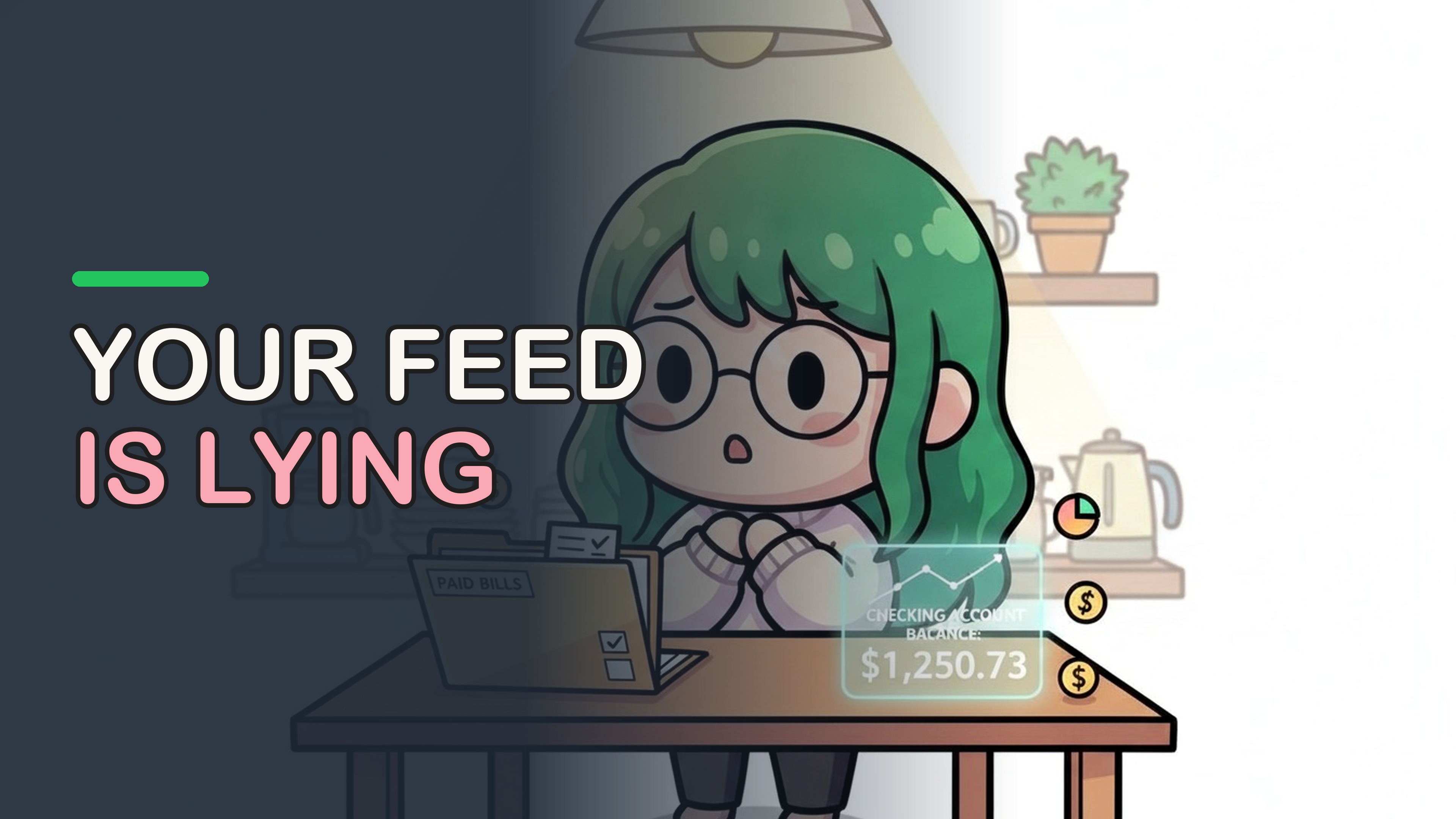
You open your phone for a two minute break and somehow watch a stranger restock a fridge that looks like a wellness retreat, reset an apartment with lamps that cost more than your grocery budget, and casually explain that her little Sunday errands were only three hundred dollars.
Your feed shows twenty people celebrating expensive milestones and none of the debt, family help, or ordinary Tuesdays around them. A curated comparison set can make a normal life feel like evidence that you failed.
Transcript
Read the full transcript
You open your phone for a two minute break and somehow watch a stranger restock a fridge that looks like a wellness retreat, reset an apartment with lamps that cost more than your grocery budget, and casually explain that her little Sunday errands were only three hundred dollars.
Then you check your own bank account and suddenly your perfectly normal life feels embarrassing.
Not broke enough for a crisis. Not rich enough for peace. Just stuck in that sour middle where you technically paid the bills, but one influencer pantry makes you feel like you are losing at adulthood.
So you start narrating your own life like evidence against you. The couch is too old. The lunches are too repetitive. The savings account is too small. Your clothes look fine until your feed reminds you that fine is apparently a personal failure with bad lighting.
And because this feeling is private, you call it discipline. You tell yourself you are bad with money, behind everyone else, secretly immature, maybe just not the kind of person who gets ahead.
But this is not a math problem first.
It is a comparison problem wearing a bank notification.
Your feed is not showing you normal. It is showing edited spending, hidden context, sponsorships, debt, family help, business write-offs, refunds, camera angles, and the one clean corner of a life that may be chaotic everywhere else.
This video is about how that turns into money dysmorphia, why it can make you spend or panic even when your numbers are not hopeless, and the private scoreboard that gets your brain back into your own life.
Money dysmorphia is not an official diagnosis. But the pattern is real enough to measure: your felt financial position gets distorted, and then the feeling starts making decisions before the numbers do.
In a Credit Karma survey, forty three percent of Gen Z and forty one percent of millennials said they experience money dysmorphia. Among people who reported it, eighty two percent said they feel behind financially. The wild part is that some still had real savings. Feeling behind did not always mean being objectively ruined.
That matters because your brain does not compare you to a spreadsheet. It compares you to what feels available, visible, and repeated.
If you see one luxury haul, you may roll your eyes. If you see hundreds of small proof-of-success clips every week, your brain quietly updates the definition of normal. Normal becomes the apartment with matching glass jars. Normal becomes the weekend trip. Normal becomes the skincare drawer, the aesthetic groceries, the new outfit for a casual dinner, the creator who says she is on a budget while unboxing your rent.
This is social comparison. Humans use other people to estimate where we stand. That is not stupidity. It is an old social survival system trying to answer a modern question: am I safe, respected, included, and on track?
The problem is that the feed is a rigged reference group.
It does not show the income behind the purchase, the credit card balance, the family support, the brand deal, the return label, the unpaid tax bill, or the fact that filming consumption can be part of someone else's job.
So if your brain feels behind after scrolling, that does not mean your life is proof of failure. It may mean your measuring tool has been hijacked.
There are seven signs your feed is lying to your money brain.
Sign one: normal starts looking too cheap.
You make coffee at home, rewear clothes, eat leftovers, split rent, and buy store-brand groceries. None of that is failure. That is regular life. But after enough polished content, regular starts to look like falling behind.
This is how comparison turns responsible choices into emotional evidence of lack. You are not just saving money. You feel like you are being excluded from the prettier version of being an adult.
Sign two: creator math replaces real math.
A creator says, "This was such an affordable find," but affordable compared to what? Her income? Her sponsorship? Her city? Her debt tolerance? Her parents' house? The tax category she uses because content is work?
Your budget cannot borrow someone else's context. A forty dollar item can be harmless in one life and a problem in another. The trap is not the amount. It is using somebody else's lifestyle as permission without seeing the machinery underneath it.
Sign three: your bank app becomes a shame mirror.
FINRA found that most banked adults use mobile devices to access checking or savings accounts. That means the bank app is not only a place where you check money. It is a tiny emotional scoreboard you can open while already feeling inadequate.
After scrolling, the same balance looks different. Before the feed, it was a number. After the feed, it becomes a verdict.
Sign four: you buy proof that you are okay.
This is the purchase that is not really about the object. The lamp, lipstick, matching set, delivery order, or apartment thing becomes proof that you are not as behind as you feel.
Research on influencer exposure connects social comparison and fear of missing out with conspicuous consumption. Translation: the object feels like a bridge between your actual life and the life your feed keeps presenting as normal.
The problem is that proof purchases expire fast. The item arrives, looks nice for ten minutes, then your feed reloads and invents a new gap.
Sign five: you over-save from panic, then rebel.
Money dysmorphia does not only create overspending. Sometimes it creates financial freezing. You feel so behind that every purchase feels dangerous, even small joys that fit your budget.
So you clamp down. No fun, no treats, no breathing room. Then after two weeks of living like a punished intern in your own life, you snap and buy something just to feel human.
That cycle is not discipline. It is panic followed by rebellion.
Sign six: validation becomes part of the checkout process.
Bank of America's twenty twenty six Gen Z study found that forty one percent experience financial guilt at least once a week, and forty percent seek validation from family or friends before or after making a purchase.
That is the loop in one sentence: buy, feel guilty, ask if it was okay, get temporary relief, then need the next reassurance.
The feed creates the insecurity. The purchase tries to soothe it. The validation tries to launder the guilt.
Sign seven: you confuse being influenced with being inspired.
Social media money content can help. It can make investing, saving, debt payoff, and budgeting feel less intimidating. But it can also turn confidence into credibility.
The CFP Board reported that many Americans question online financial information monthly, yet many still turn to social media for advice. New America found that young adults are often navigating financial content in spaces that reward confidence, relatability, repetition, emotional appeal, and shareability.
In other words, advice can feel true because it arrives at the perfect emotional moment, not because it fits your numbers.
Here is the cruel part.
The more you try to spend your way into feeling caught up, the more you can delay the private security that would actually make you feel calm.
You buy the thing because you want to stop feeling behind. But if the money came from your emergency fund, your credit card, your rent buffer, or the tiny amount you were going to transfer before payday, the purchase does not close the gap. It moves the gap behind a prettier object.
And then the feed makes the object ordinary again.
This is why the shame is so sticky. You are not only upset about the money. You are upset because the purchase was supposed to change how your life felt, and it did not.
So please hear this without snark: you cannot build peace by obeying a comparison machine.
The machine does not have a finish line. If you upgrade your apartment, it will show you a better one. If you buy the bag, it will show you a closet. If you save ten thousand dollars, it will show you someone your age buying a house with a vague caption about gratitude and no mention of family money.
Your feed is allowed to be endless.
Your financial life is not.
It has rent, food, debt, savings, income, time, energy, and tradeoffs. That is not embarrassing. That is reality. And reality is the only place where money can actually protect you.
The fix is the private scoreboard system.
Not a fantasy budget. Not a no-buy challenge designed like a personality transplant. A scoreboard that tells you whether your actual life is getting safer.
Pick four numbers.
Number one: monthly surplus. After bills and necessary spending, did money stay with you?
Number two: emergency months. How much time could your savings buy if income got weird?
Number three: debt drag. How much of next month's income is already claimed by past decisions?
Number four: automatic proof. Did a transfer, debt payment, or investment happen before your mood got involved?
These numbers are boring on purpose. Boring is the point. Visible spending is loud. Private security whispers. You need a way to hear it.
Then add feed friction.
Before you scroll shopping, beauty, apartment, travel, or rich-life content, check one private metric first. Not to punish yourself. To anchor yourself.
If a post makes you want to buy something to feel less behind, use a twenty-four-hour pause. Put it in a note. Write the feeling next to it. Not "lamp." Write, "I want my home to feel adult." Not "dress." Write, "I want to feel chosen at dinner." Not "planner." Write, "I want my life to feel under control."
Now you can solve the actual job.
Maybe your home needs one warm lamp, not a full apartment identity crisis. Maybe dinner needs a clean outfit you already own. Maybe control needs a fifteen minute money check, not a new notebook pretending to be a system.
Next, audit the feed. Mute accounts that reliably make you feel urgent, humiliated, or financially fake. You do not need to hate them. You just need to stop handing them access to your nervous system.
Keep accounts that show process, context, realistic numbers, repair, rewearing, debt payoff, ordinary apartments, and actual tradeoffs. Your feed should make reality easier to live in, not harder.
And keep a small planned joy fund.
Because the goal is not to become a joyless little spreadsheet with lip gloss. The goal is to stop letting insecurity pick the timing, price, and meaning of your purchases.
When joy is planned, it can stay joy. When joy is panic in a cute outfit, it sends an invoice later.
So the next time your feed makes you feel behind, do not start by asking, "What is wrong with me?"
Ask, "What did this just make me compare?"
Was it your apartment, your body, your clothes, your food, your job, your savings, your relationship status, or your entire future before breakfast?
That answer is the doorway out.
Because once you can name the comparison, you can stop treating the purchase as the cure.
Your life does not need to look expensive to be moving forward. It needs margin, options, honesty, and a scoreboard that belongs to you.
Comment with the feed category that lies to you the hardest: apartments, beauty, clothes, food, travel, or rich-life content.
And send this to someone who keeps feeling behind after scrolling, because they may not need another budget tip. They may need to know the measuring tool is broken.
Sources & further reading
These are the research sources reviewed for this episode. Evidence and guidance can change; updated entries show a new date above.
- Intuit Credit Karma, "Gen Z and millennials are obsessed with the idea of being rich, and it could be leading to money dysmorphia," January 17, 2024— creditkarma.com
- Bank of America, "BofA Study Finds Fewer Gen Z Rely on Family for Financial Assistance, Even With 42% Living Paycheck to Paycheck," May 19, 2026— newsroom.bankofamerica.com
- Dinh and Lee, "Social media influencers and followers' conspicuous consumption: The mediation of fear of missing out and materialism," Heliyon, August 2024— sciencedirect.com
- 2024— sciencedirect.com
- CFP Board, "Gen Z Says TikTok Is the Least Trustworthy Place for Financial Advice - And Then Uses It Anyway," March 16, 2026— cfp.net
- May 2026— newamerica.org
- 12, 2025— talkerresearch.com
- FINRA Investor Education Foundation, "National Study by FINRA Foundation Finds More U.S. Households Struggling Financially Despite Stable Incomes," July 22, 2025— finra.org
- Intuit Credit Karma, "Americans Are Embracing 'No-Buy' or 'Low-Buy' Challenges to Rein in Spending," 2026— creditkarma.com
More in Spending Psychology



Start with your own patterns
The free Money Pattern Lab turns seven ordinary days into one clearer picture of your spending triggers.
Your PDF opens immediately. Confirm your email for the free welcome series and weekly letter. Unsubscribe whenever.