POV: You Keep Saying "I Deserve It" Until You're Trapped
Summary
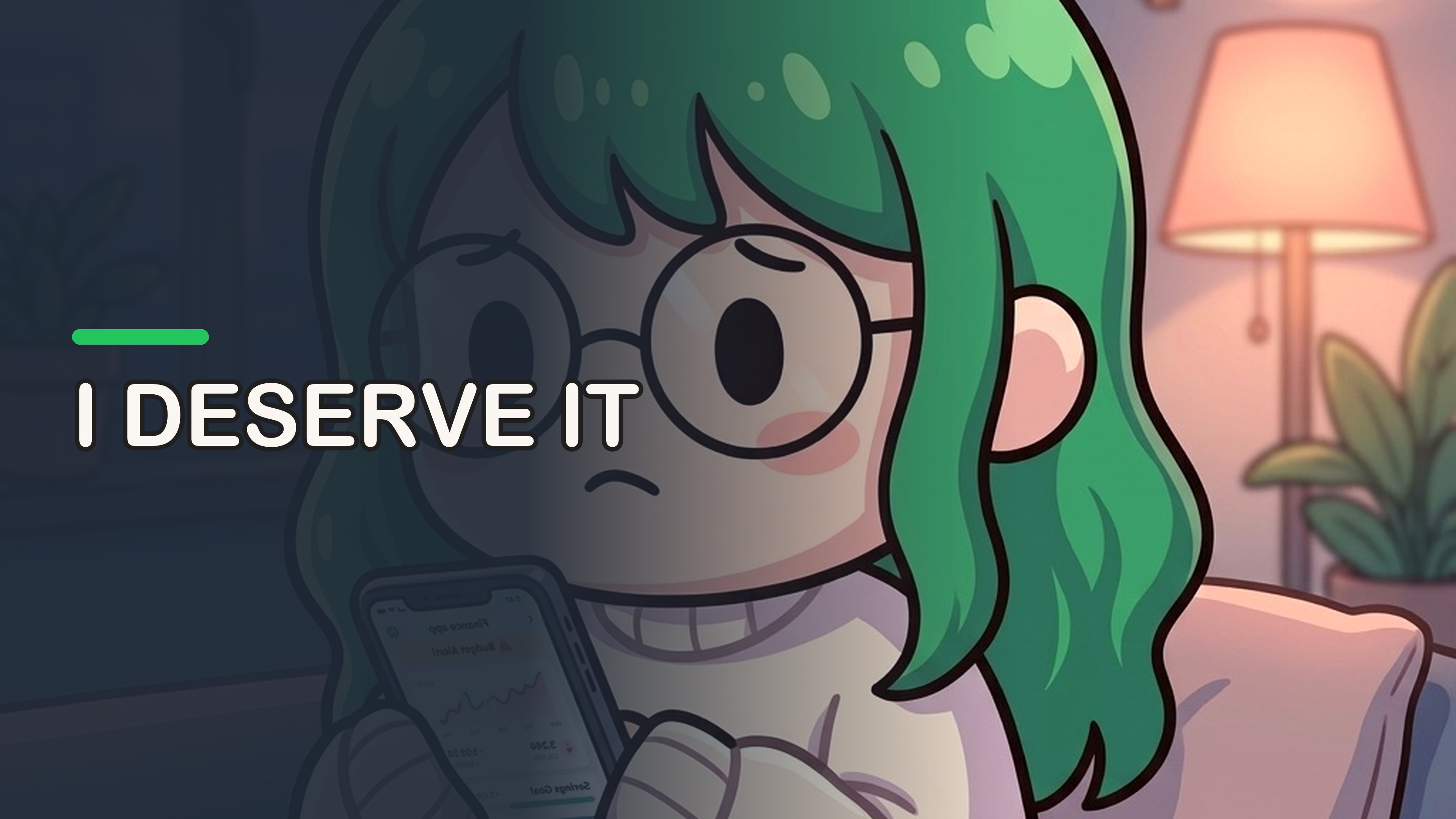
It is the end of a long day, and your thumb is hovering over the checkout button. The cart is already full.
You did survive the week, and wanting relief is not the problem. The trap begins when every hard feeling receives a checkout button and next week's paycheck inherits the bill.
Transcript
Read the full transcript
It is the end of a long day, and your thumb is hovering over the checkout button. The cart is already full. You did not plan any of it. A candle. A hoodie. The good skincare. Dinner you did not cook. And a small voice in your head says the words you always say. I deserve it.
And here is the thing. You do.
You got through the day. You answered the messages, you held it together, you were good. Nobody handed you a medal, so you are handing yourself this. It is not stupid. It is not even really about the candle. It is a small, private ritual for surviving something that did not leave a mark anyone else can see.
So let us get one thing straight before we go any further. You are not bad with money. You are not weak, or frivolous, or broken. The relief you feel when you check out is real. Researchers can actually measure it.
But something happens after the box arrives. The relief is gone by the weekend, and somehow the wanting is back. Same tired, same cart, same three words.
This is the story of how I deserve it stops being a treat and quietly becomes a trap. Not because you are undisciplined. Because the loop is built to keep you on it. So let us take it apart.
Here is what is actually happening when you reach for the cart after a hard day.
Psychologists call it compensatory consumption. When you feel a gap between the life you are living and the life you wanted, your brain looks for the fastest way to close it, and shopping is right there, open in another tab. It is not really shopping. It is a distraction with a delivery date.
And the relief is real, but not for the reason you think. Researchers ran experiments where sad people got to make shopping choices, and their sadness went down. Here is the strange part. It worked even when the shopping was completely imaginary. A pretend cart. No money. No package. The relief did not come from buying anything. It came from choosing. After a day where everything happened to you, choosing something, anything, hands a little control back.
Sit with that for a second, because it changes everything. The part that actually makes you feel better is the deciding. The spending is just the expensive habit that got attached to it.
And then there is the permission slip. You had a hard day, so the guilt that normally whispers maybe not just switches off. I earned this. Psychologists have a name for that too. It is called licensing. And in the studies, most people do not even notice they are doing it.
So once you see the loop, you start seeing its symptoms everywhere. Here are six.
Number one. The permission slip.
It always starts with something you earned. A brutal week. A workout. A hard conversation you finally had. You did a good thing, and the good thing quietly signs off on the reward. In one survey, eighty-four percent of people said they justify their purchases with exactly this, some version of I deserve it, or I will treat myself. The money problem is that these buys never make it into a budget, because they do not feel like spending. They feel like self-care. And the tax you pay is the little courtroom in your head, where you are somehow both the lawyer and the judge, arguing for something you already put in the cart.
Number two. The cart high.
Remember, the good feeling peaks when you choose, which means it peaks before the box even ships. By the time it arrives, the high is already fading, and the thing itself just becomes stuff. This is why the fourth candle never feels like the first one did. Not because you need a bigger candle, but because the newness wears off fast, and the feeling you were chasing was never in the box to begin with. The cost is a shelf of things that each promised a lift and delivered a Tuesday. The tax is the quiet why did I even buy this that you feel while you put it away.
Number three. The treat that signs you up.
Some treats do not end. The little upgrade, the app, the subscription box, the premium tier. One relaxed yes on a hard night, and now it renews every month, forever. And you lose track. In one survey, people guessed they spent about eighty-six dollars a month on subscriptions. When they actually sat down and added it up, it was two hundred and nineteen. Two and a half times more than they thought. More than forty percent admitted they were still paying for something they had already stopped using. The money problem is a quiet stack of small monthly charges you stopped noticing months ago. The tax is that you avoid adding them up, because some part of you already knows what you will find.
Number four. Pay later.
When paying hurts, you buy less. So the entire checkout is designed to make it stop hurting. Save the card. One click. Or better yet, split it into four easy payments, so tonight it feels almost free, and some future version of you gets the bill. But here is what the data shows. In a large study of real credit records, people's balances were already climbing in the year before their first buy now, pay later purchase. The strain came first. The treat came second. And the people leaning on pay later were quietly carrying more debt of every other kind too. The tax is four different apps, four different due dates, and a future you who inherits all of it while you are still deciding tonight feels fine.
Number five. The treat that bites back.
Sometimes you buy the thing to feel better about one specific insecurity, and it does the exact opposite. You wanted to feel put together, so you bought the outfit, and now the outfit is just a little reminder that you did not feel put together in the first place. Researchers found that buying to patch a specific gap can actually deepen it, because the purchase makes you think about the gap. The money is spent, and the feeling you were trying to fix is now louder than before. That is the cruelest tax of all. Paying to feel worse.
Number six. Doom spending, on command.
None of this happens in a vacuum. Treat yourself is not just something you say to yourself. It is a marketing strategy, aimed directly at you, at the exact hour you are most tired and least able to argue. The feed is full of people rewarding themselves, so it looks normal, even overdue. In one survey, nearly a third of people described their own spending as doom spending, buying just to feel something when the world feels heavy. A major bank looked at all of this treat culture and called it, in plain terms, a slippery slope. The consequence is that overspending slowly stops feeling like overspending. And the tax is comparison, the low hum that everyone else is treating themselves too, so falling behind would be the one thing you cannot afford.
Now step back and look at the whole loop at once, because this is the part nobody puts on a thumbnail.
The reward you buy to escape the pressure is quietly funding next month's pressure.
Think about it. The money is gone. But a lot of the time the bill is not. It renews, or it is split into payments, or it just left your account a little thinner than before. And the thing that actually sent you to the checkout, the tiredness, the feeling behind, the long day, all of that is still there. Untouched. You could not buy your way out of it, because it was never for sale.
So the margin gets a little tighter. And a tighter margin means a little more stress. And a little more stress means that, at the end of the next long day, you are right back where you started. Thumb over the button. Telling yourself the same three words.
This is the part people get wrong about it. It is not that you keep needing a bigger and bigger hit. It is quieter and sadder than that. You are running just to stay in the same place, while the small bills stack up behind you. That is not a shopping problem. That is a treadmill.
And the hardest thing to admit is what you actually deserve. It was never the candle. It is rest. Room to breathe. A little security. None of which, it turns out, was ever in the cart.
So how do you step off? Not by becoming a different, more disciplined person. That person is not coming, and honestly, you do not need her. You just need to change the loop, in a few specific places.
First, decide your rewards before the hard day, not during it. Give treating yourself an actual budget, a small amount that is genuinely yours to spend on nothing but joy, and set that money aside first, at the start of the month, before anything else can claim it. This is the one move with the most real evidence behind it. Deciding in advance and locking it in beats willpower in the moment, every single time, because the tired version of you at ten at night is no longer the one making the call. The morning version already made it.
Second, keep every reward a one-time thing. If a treat renews, it is not a treat. It is a bill wearing a bow. Buy the nice coffee. Do not subscribe to the coffee. And once a month, actually open your subscriptions and cancel one. You will not miss it. Remember, more than forty percent of people are paying, right now, for something they already stopped using.
Third, put the friction back. Take your card off the sites. Delete the one saved in your browser. Turn off the pay later option. You want paying to feel like something again, because that little sting is not your enemy. It is information.
Fourth, and this is the strange one that actually works. When the urge hits, let yourself shop. Fill the entire cart. Choose everything. And then close the tab. Remember what the research found. The relief was in the choosing, not the buying. So take the free part, and skip the expensive part. Most of the time, twenty-four hours later, you will not even remember what was in there.
And last, when you can, give the real need the real thing. If the honest problem is that you are exhausted, a package is not going to fix exhausted. Rest will. It is free, it is somehow harder than shopping, and it is the only thing that actually turns the trigger off.
None of this is about never treating yourself. Please, treat yourself. It is about making sure the treat stays a treat. One you chose on purpose, funded on purpose, that ends when it is over, and never quietly turns into the thing keeping you stuck.
So here is the question I would actually love you to sit with, and answer honestly down in the comments.
Which reward is your loophole? The delivery order, the subscription you forgot about, the four easy payments, the little treat that always signs you up for one more month? And what is the recurring bill it quietly left behind?
Naming it is not about guilt. You were never the problem here. You were a tired person doing a completely human thing, being sold a completely engineered solution. The only difference now is that you can see the loop while you are standing in the middle of it. And that is the whole game. You cannot step off a treadmill you did not know you were on.
And if someone came to mind while you were watching, someone stuck in the same loop, telling themselves the same three words, send this to them. Not to call them out. Just so they can see it too.
You deserve rest. Go get the free thing.
Sources & further reading
These are the research sources reviewed for this episode. Evidence and guidance can change; updated entries show a new date above.
- Psychology 2017— myscp.onlinelibrary.wiley.com
- Atalay & Meloy 2011, Psychology & Marketing— onlinelibrary.wiley.com
- Rick, Pereira & Burson 2014, J. Consumer Psychology— sciencedirect.com
- Khan & Dhar 2006, J. Marketing Research— w4.stern.nyu.edu
- Lyubomirsky 2011, Oxford Handbook chapter— sonjalyubomirsky.com
- behavioraleconomics.com— behavioraleconomics.com
- Glöckner 2016, Judgment and Decision Making— cambridge.org
- CFPB, Consumer Use of Buy Now, Pay Later and Other Unsecured Debt, Jan 13 2025 (6.1M consumer-months, de-identified credit records)— consumerfinance.gov
- C+R Research 2022 (n=1,000)— crresearch.com
- Clever Real Estate 2024 (n=1,099)— listwithclever.com
- (n=1,950)— lendingtree.com
- fortune.com— fortune.com
- secondary)— bankrate.com
- dos.ny.gov— dos.ny.gov
- Ashraf, Karlan & Yin 2006, QJE— navaashraf.com
- ending by mechanism/analogy — present as "deciding in advance and locking it in beats willpower in the moment," not a promised percentage. Related precommitment principle: Save More Tomorrow (Thaler & Benartzi, JPE 2004,— journals.uchicago.edu
More in Spending Psychology
Start with your own patterns
The free Money Pattern Lab turns seven ordinary days into one clearer picture of your spending triggers.
Your PDF opens immediately. Confirm your email for the free welcome series and weekly letter. Unsubscribe whenever.