POV: You "Split It Into 4"… Now Every Paycheck Is Already Spent
Summary
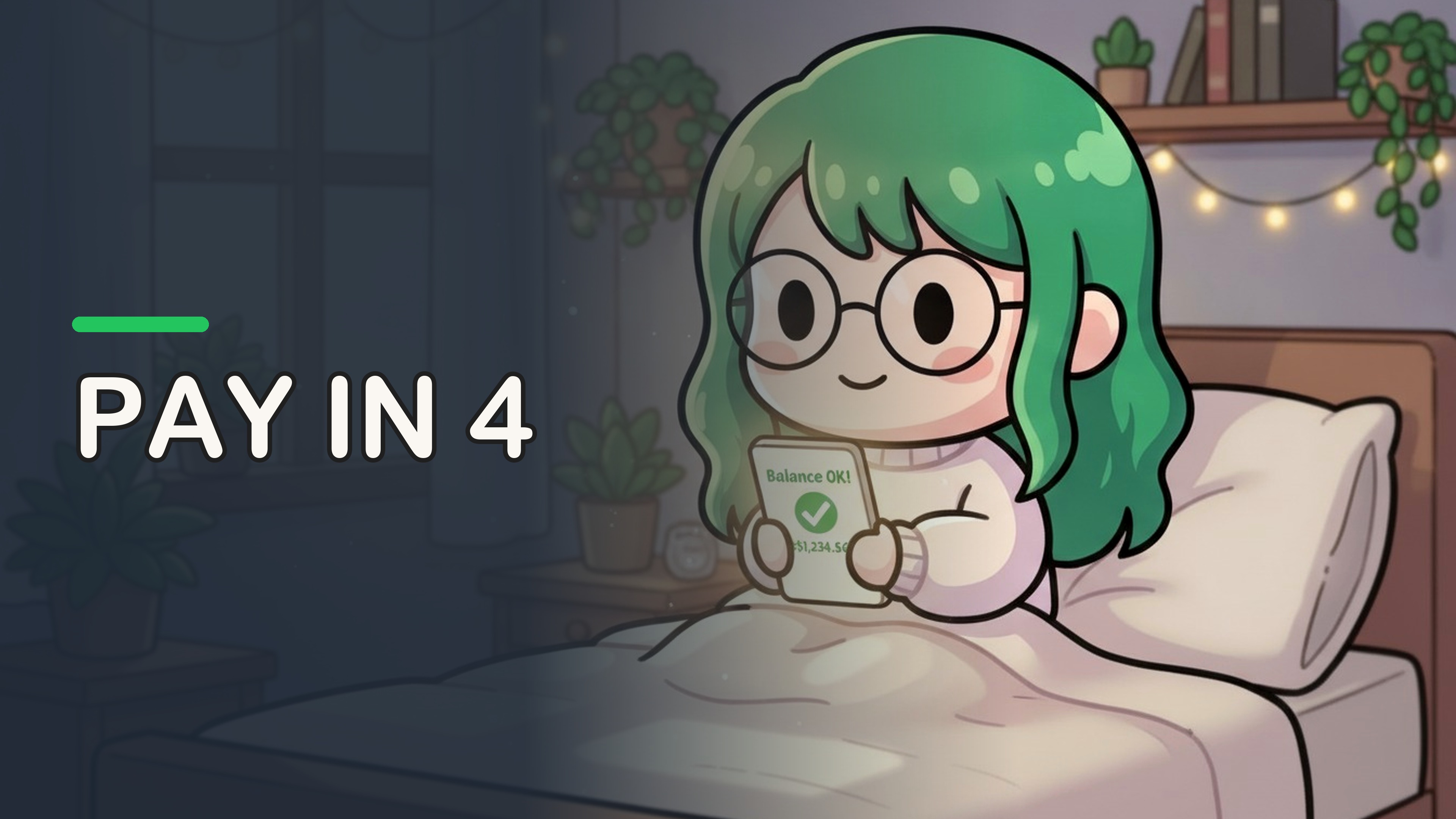
It's Friday. Payday.
The payment looked small because the total was pushed out of frame. Buy now, pay later turns one decision into four claims on paychecks that have not arrived yet.
Transcript
Read the full transcript
It's Friday. Payday. The deposit hits at six in the morning, and for about an hour, your balance looks like proof that you're doing okay. Then the first withdrawal lands. Twenty-three dollars. Then another app takes nineteen. Then a third one you genuinely don't remember agreeing to. By lunch, the paycheck you waited two weeks for has already been divided up by decisions you made weeks ago, and you can't even name what half of them were for.
So you do what you always do. You call yourself bad with money. Irresponsible. You promise this is the last time you split anything. And then Sunday night, a checkout page offers you four easy payments of thirteen dollars, and it doesn't feel like debt. It feels like budgeting.
Here's what nobody says out loud. You never miss a payment. You have never technically been in debt in your life. And you are still, somehow, always broke.
That is not a discipline problem. That is a checkout button running published psychology on your brain. Psychology so effective that stores pay real money to put it in front of you.
In the next few minutes, I'll show you exactly what split it into four does to the way your brain prices things, the seven signs it's already running your paychecks, and the one rule that shuts the whole machine down.
First, the absolution, because you've been blaming the wrong suspect. Behavioral economists have known since the nineties that paying hurts. Literally. Handing over money triggers something researchers call the pain of paying, and that pain is the brake pedal in your brain. It's what makes you pause and ask, do I actually want this?
Every payment technology since cash has been engineered to soften that brake. Cards blurred it. One click weakened it. Pay in four is the newest model, and it does two things at once. It decouples the purchase from the payment, so the joy happens now and the cost arrives later as four anonymous little deductions that no longer feel connected to the shoes. And it reframes the price. Researchers call it pennies a day framing. The same cost, presented as small ongoing amounts, gets compared to coffee money instead of rent money. Two hundred dollars is a decision. Fifty dollars four times is a shrug.
None of this is a conspiracy theory. It's published research, and the companies know it works. In one large randomized experiment, just offering pay later at checkout lifted sales by twenty percent. Not because people were dumb. Because the brakes were off.
And if things were already tight before you ever tapped that button, that's not a coincidence either. In government credit data, people's card balances were already climbing in the year before their first pay later loan. The strain comes first. The app just shows up dressed as the solution.
Your brain isn't broken. It's doing exactly what brains do when the pain is removed. It buys.
So how do you know if this has moved from convenience to trap? Here are the seven signs. Count how many are yours.
Number one. You know your payments, but not your total. Ask yourself right now, across every app, how much do you still owe? You know Thursday is twenty-three dollars. You know the fifteenth is nineteen. But the total? No idea. That's mental accounting doing what it does. Four small charges never get filed as one big one. And here's the unsettling part. Nobody else knows the number either. The apps can't see each other's loans. For years, credit bureaus couldn't see any of it. Economists literally named it phantom debt. The only place your real total exists is in the slow leak of your balance, and in that low grade hum of not quite knowing that follows you around all month.
Number two. The price you weigh is not the price you pay. When a top costs forty-eight dollars, some part of you negotiates. When it says four payments of twelve, the negotiation never starts, because twelve dollars is lunch, and your brain compares it to lunch. That's the reframe working exactly as designed. And the research shows where the damage lands. The extra spending comes mostly from small purchases. Not the couch. The twelfth forty dollar top. The average pay later loan is about a hundred and thirty-five dollars. This machine was never built for furniture. It was built to make small yeses feel like nothing, hundreds of millions of times a year.
Number three. You're running more than one app. One for this store, another for that one, a third for everything else. In the government's own data, sixty-three percent of borrowers held more than one of these loans at the same time, and a third were juggling loans across different companies. The average user was taking out nine or ten a year. So your payment calendar becomes a second job. And the exhaustion tax is you, at two in the morning, scrolling three different apps, trying to reverse engineer why Friday's paycheck is already gone.
Number four. You check which paycheck it lands on. Before you split something, you do that little forward math. Two payments hit the next check, one hits the one after. That feels responsible. It's actually the tell. It means present you is spending future you's income, on pure confidence that future you will be fine. Researchers call it overconfidence in future liquidity. You're not lying to yourself. You're just always wrong by a little. And a little, four times a month, is your entire margin. Payday stops feeling like relief, because every paycheck arrives with its hands already tied.
Number five. Autopay keeps surprising you. The whole point of the split is that you stop thinking about it. That's the decoupling. So the withdrawals arrive like weather. And when four apps are pulling on their own schedules, none of them checks your balance first. In banking records covering millions of people, new pay later users saw their overdraft fees and their credit card interest climb right after they started. Read that again. The product with no interest quietly generates interest. It just routes the bill through your bank instead. The exhaustion tax is that flinch before you open your banking app. You know the one.
Number six. You're splitting things that are gone before the payments are. Pay in four on a jacket is one thing. But in one recent survey, twenty-nine percent of users said they had used it for groceries, more than double what it was two years earlier. Dinner. Concert tickets. A weekend trip. When the thing is consumed in week one and the payments run to week six, you're not financing a purchase anymore. You're borrowing from four future versions of yourself to pay for a Tuesday that's already over.
Number seven. You feel responsible, because you never miss. This is the sign nobody claims, so listen closely. You pay on time. Almost everyone does. About ninety-eight percent of these loans get repaid. Your record is spotless. And you're still broke at the end of every month. If you've been using that perfect record as proof that everything is fine, here's the reframe you need. The machine never required your failure. On time and broke is not you beating the system. It is the system.
Now step back, because the paradox is the whole story. You were taught that debt trouble looks like missed payments, collection calls, late fees. So you check your record. Never missed. No fees. Nothing scary on any report. By every rule you were ever taught, you're winning.
But look at how this business actually makes money. Late fees? About ten dollars on average, and shrinking. A rounding error of their revenue. Defaults? Around two percent. They do not need your failure. Stores pay these companies up to seven percent of every purchase, several times what a credit card costs them, because the split makes you buy more. That is the deal. The store is not doing you a favor. The store is buying your future spending. You're not the customer of that free financing. You're the product being delivered.
Which means the success case, you, paying every installment on time, forever, was never the loophole. It's the business plan. Your paychecks arrive pre spent, in amounts no bureau, no lender, no app, and no version of you can see totaled anywhere. You did everything right. And every two weeks, the proof that you're fine is withdrawn automatically, nineteen dollars at a time.
You were never bad with money. You were paying invisible debt with a perfect record.
So here's the system that breaks it. One rule, three supports. You can run it tonight.
The rule. If you can't buy it in one payment today, you can't afford it.
Not as punishment. As re coupling. The split works by removing the pain of paying, and the pain of paying was never your enemy. It was information. Buying in one payment puts the brake pedal back in the car. If the full price makes you flinch, that flinch is the point. It's the part of you that knows the difference between a want you can carry and a want that will carry you.
Support one. Total cost translation. Before any checkout, say the whole number out loud. Not four easy payments of fifty-two. Two hundred and eight dollars. Out loud, in words. Your brain evaluates the number you hand it, so hand it the real one. If it sounds absurd spoken, it was absurd silently.
Support two. The paycheck test, inverted. If you catch yourself calculating which paycheck each installment lands on, that math is your answer. Anything that needs four future paychecks to feel affordable is not affordable. It's pre spending your relief. Payday should feel like arrival. Not like a sweep.
Support three. Put the friction back. Log out of every pay later app. Delete the saved card at your favorite stores. Move the apps off your home screen. Researchers watched spending jump when one click checkout removed friction, so run the experiment in reverse. Make the machine slow again. Ten extra seconds is enough time for your brain to reboot the question, do I actually want this?
And one heads up while you're at it. The invisibility is ending. Starting last year, these loans began showing up on credit reports and feeding into new credit scores. The phantom is becoming visible to lenders. Better it becomes visible to you first.
So do this tonight. Open every app. Add up what's left. Write that one number where you can see it. You can't negotiate with a number you refuse to know. And facing it isn't failure. It's the first move the machine never planned for you to make.
Before you scroll to the next video, here's your self diagnosis. Open every pay later app on your phone. Add up what's still owed. One number. Then tell me in the comments, did you know your number before you added it up? Be honest. Nobody down there is judging, because almost nobody knows theirs either.
And tell me which sign hit hardest, one through seven. The two a m app juggling? The paycheck math? The perfect record that never buys you any actual room to breathe?
If someone you love is mid split right now, three apps deep, paying everything on time, wondering why it never gets easier, send them this. Not as a call out. As a flashlight.
You were never bad with money. You were playing on time against a machine designed to stay invisible. It's visible now. And a paycheck that arrives already yours, all of it, is worth more than anything you could split it into.
Sources & further reading
These are the research sources reviewed for this episode. Evidence and guidance can change; updated entries show a new date above.
- Maesen & Ang 2025, Journal of Marketing— journals.sagepub.com
- Prelec & Loewenstein 1998, Marketing Science— pubsonline.informs.org
- Gourville 1998, Journal of Consumer Research 24(4)— academic.oup.com
- (low-ticket concentration) Journal of Retailing 2024— sciencedirect.com
- J. Theor. Appl. Electron. Commer. Res. 2025— mdpi.com
- Cornell news on Management Science study (Feb 2023)— news.cornell.edu
- Berg, Burg, Keil & Puri 2024, NBER WP 33152— nber.org
- Katz & Williams, NBER WP 30508— nber.org
- deHaan et al., Management Science— pubsonline.informs.org
- CFPB, Consumer Use of Buy Now, Pay Later and Other Unsecured Debt, Jan 13 2025— files.consumerfinance.gov
- CFPB, Consumer Use of Buy Now, Pay Later (Making Ends Meet), Mar 2023— files.consumerfinance.gov
- CFPB BNPL market report, Dec 2025— files.consumerfinance.gov
- Richmond Fed Economic Brief 26-05, Feb 2026— richmondfed.org
- Wells Fargo Economics— wellsfargo.bluematrix.com
- Fortune, May 2024— fortune.com
- ION: Affirm began reporting to Experian/TransUnion in 2025; FICO announced BNPL-inclusive scores (fall 2025); Klarna and Afterpay have cautioned against reporting; Sezzle is opt-in (Richmond Fed, Feb 2026; CNBC, Jun 2025— cnbc.com
- Source— lendingtree.com
More in Cash Flow & Budgeting
Start with your own patterns
The free Money Pattern Lab turns seven ordinary days into one clearer picture of your spending triggers.
Your PDF opens immediately. Confirm your email for the free welcome series and weekly letter. Unsubscribe whenever.