POV: You're Paying for Subscriptions You Forgot You Had
Summary
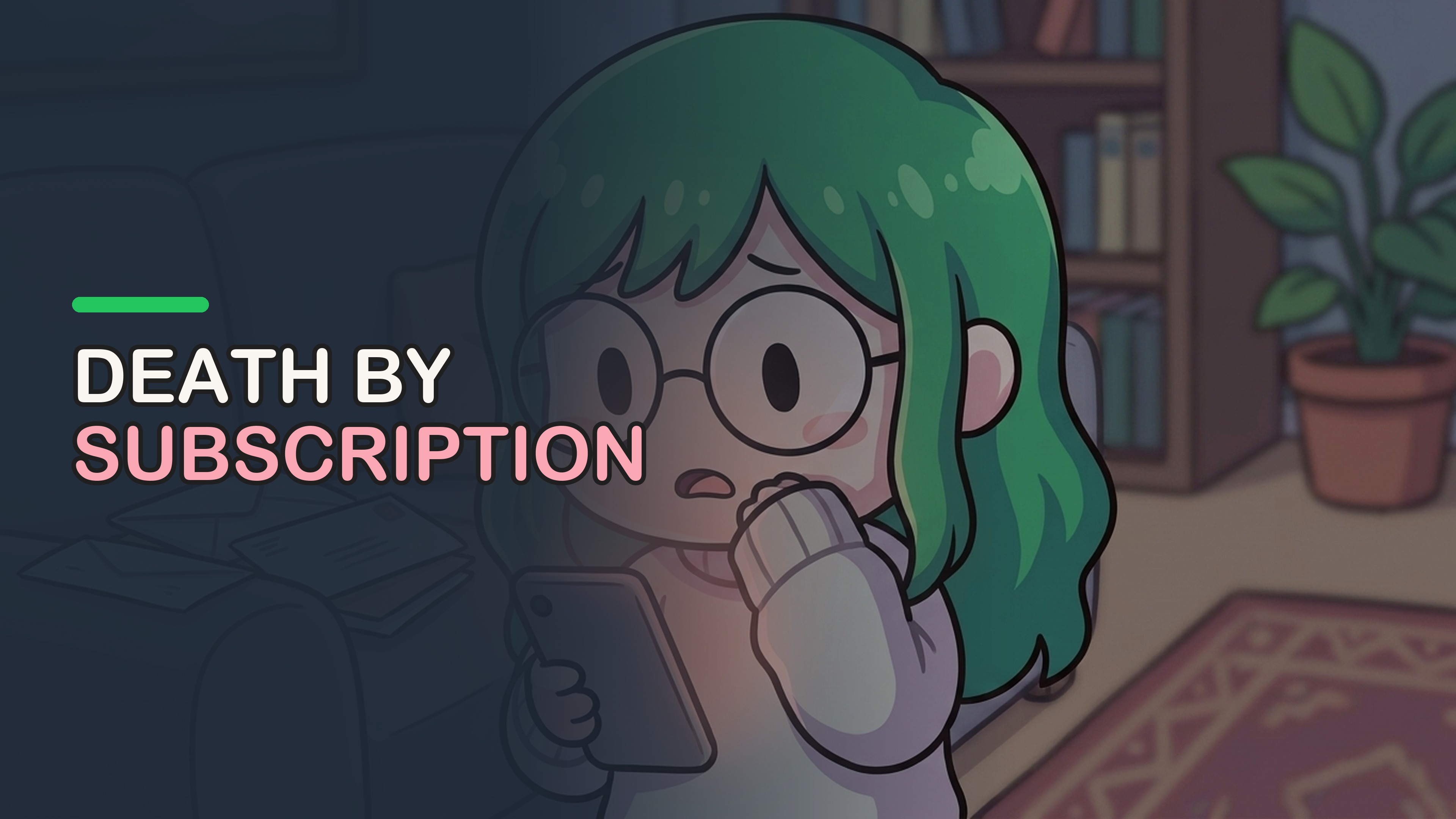
You open your banking app to check one thing, and you make the mistake of actually reading it. And there they are.
Nothing looks outrageous on its own: nine dollars here, fourteen there, and one annual renewal you forgot existed. Subscription spending wins by becoming too small and too automatic to reconsider.
Transcript
Read the full transcript
You open your banking app to check one thing, and you make the mistake of actually reading it. And there they are. A charge for nine dollars you don't recognize. A thirteen-dollar one you kind of do, from a company whose name you'd have to look up. Something for four ninety-nine that just says the word plus and a number. You scroll, and it keeps going. Little charges, sitting in your account like they pay rent there. You do the thing where you squint and think, wait, am I still paying for that.
And here's the part you don't say out loud. You are. You're paying for all of it. The app you downloaded for one free trial. The streaming service you signed up for to watch one show. The gym you have driven past, guiltily, for five straight weeks. The box, the cloud storage, the second cloud storage, the meditation app that was supposed to fix your life in January.
So you close the app. Because looking at it feels worse than not knowing. And you tell yourself the thing we all tell ourselves. That you're just bad with money. Disorganized. The kind of person who lets this happen.
You're not. That's not what this is. What's actually happening to you is one of the most quietly engineered things in your entire financial life, and once you see how it's built, you can take it apart in an afternoon. Let me show you the machine.
Here's the first thing you need to hear. You did not overspend twelve times. You said yes once. And then nobody ever asked you again.
That is the entire trick, and it runs on three things your brain does automatically. The first is called payment decoupling. When you hand over cash, it stings a little, and that sting is useful. It's the brake. It's the small pain that makes you check whether something is worth it. A subscription removes the sting completely. Ten dollars leaving your account on autopilot, on a Tuesday, while you sleep, does not feel like a purchase. It doesn't feel like anything. So the brake never touches the floor.
The second thing is the default effect. Whatever happens automatically is what people keep. Not because they chose it, but because choosing to stop takes effort, and staying takes none. Auto-renewal is that fact, weaponized and pointed at you. The setting is quietly flipped to keep charging you, and the company is betting you won't flip it back.
And the third thing is friction, on purpose. Signing up took one tap. Cancelling takes a scavenger hunt. Hidden menus, a login you forgot, a page that begs you to stay, a discount that appears at the exact second you try to leave. That gap, between how easy it is to start and how hard it is to stop, is not an accident. It's the product.
You're not careless. You're just outnumbered.
So let's name them. Seven signs a subscription has quietly turned into money you're just donating. See how many are living in your account right now.
Number one. The charge you cannot identify. You look at your statement and there's a name you don't recognize, for an amount you don't remember agreeing to. This is mental accounting doing its job against you. Each charge is small enough to feel like nothing, so your brain never adds them up. Ten dollars a month feels like nothing on its own. But a whole stack of little charges like it, that you never add up, is not small money. Added up, it's a car-insurance payment leaving every month, for nothing. And the reason each one survives is that it lives just beneath the size where you'd bother to investigate. It hides inside its own smallness.
Number two. The free trial that grew up. You signed up for seven free days, fully intending to cancel on day six. You put in your card because they made you. And then life happened, day six came and went, and the trial quietly became a paying customer. That is not you being forgetful. Companies design trials around the fact that you will forget. The card requirement was never for the trial. It was for the conversion.
Number three. The one you'll cancel after this month. You know about this one. You've clocked it. You've even said, out loud, I need to cancel that. And then you didn't, because cancelling is a future-you problem, and future-you keeps not showing up. This is present bias. The tiny effort of cancelling always loses to later, and later renews the charge every single time it fails to arrive. Your bank has heard I'll cancel after this month four times this year.
Number four. The duplicates. Three streaming services. Two cloud storages you're paying for because your phone got full and it was easier to buy space than to delete photos. Two different apps that do almost the same thing. You're not using more. You're paying more, for overlap you would never choose if you saw it all on one screen. Which is exactly why you never see it on one screen.
Number five. The gym. Or the language app, or the online course, or the class you bought in a burst of hope. Let me give you the most honest number in personal finance. Researchers studied people who bought monthly gym memberships, and found they paid around seventeen dollars for every visit they actually made, when a pay-per-visit option would have worked out to about ten dollars a visit. They didn't do the math wrong. They overestimated how often future-them would go, and then they were painfully slow to cancel once they didn't. You are not paying for the gym. You are paying to still believe you'll become the person who goes.
Number six. The tier you never turned down. At some point you got upgraded, or you clicked the middle option, or the price crept up a dollar or two at every renewal. And a few renewals later, you're quietly paying half again as much for the exact same thing you had before. You didn't upgrade. The price did, while you weren't looking. Prices climb quietly and almost never come back down on their own. The plan you're on is rarely the plan you would pick today. It's just the plan that happened to you.
Number seven. The one that's genuinely hard to leave. You've actually tried to cancel this one. And it made you call a phone number, during business hours, to talk to a person whose entire job is to keep you. So you gave up, because your time is worth more than the ten dollars, and they are betting on exactly that. When cancelling is that hard, it isn't because the technology is difficult. It's a wall, built on purpose.
If you counted more than two of those, I promise you are not the problem here. You are the target.
Here's the part that actually stings, and I'm not going to dress it up. Every one of these subscriptions started as a yes to something good. Convenience. Entertainment. Becoming healthier, calmer, more interesting. You didn't sign up for junk. You signed up for a better version of your life.
But look at what it turned into. You are now spending real money, every month, on convenience you're not using, entertainment you're not watching, and versions of yourself you haven't become. And because it never feels like spending, because there's no bag to carry home and no moment of handing over cash, it is the most expensive kind of money you have. It's the money you don't defend, because you don't even feel it leave.
Surveys keep finding the same thing. People guess they spend under a hundred dollars a month on subscriptions, and then they actually add it up, and it's two hundred, sometimes more. That gap, the difference between what you think you're spending and what you're actually spending, is not a rounding error. It's the emergency fund you keep meaning to start. It's the invested money that would quietly make you free. A couple hundred a month, invested at a normal market return instead of forgotten, could grow to around a quarter of a million dollars over thirty years. It's already leaving your account. It's just leaving for things you'd never choose again if anyone stopped and asked you.
So here is the fix, and it is not become a more disciplined person. Discipline was never the problem. The problem is that these charges stopped being decisions. So the fix is simple. You are going to make every one of them a decision again. Once. This weekend.
Step one. Pull the receipts. Open your bank statement, every card, and your phone's subscriptions page, and write down every single recurring charge in one place. Not in your head. On one screen, one list, where you can finally see the pile instead of the pieces. This part is uncomfortable, and the discomfort is the point. It's the exact feeling the whole system was built to keep you from having.
Step two. Cancel on sight. Anything you have not used in the last thirty days, you cancel now. Not I might use it. Not maybe this summer. If you haven't opened it in a month, non-use is your answer. Remember the gym. Future-you is optimistic and slightly fictional. Believe your actual behavior instead.
Step three. For everything that survives, run one question. Would I sign up for this today, at full price, knowing exactly what I know now. If the answer is anything other than an easy yes, cancel it. This flips the default back where it belongs. Now keeping something takes a real yes, instead of just a failure to say no.
Step four. Take whatever you just freed up, and this is the step most people skip, and move it. Today. Set up an automatic transfer of that exact amount into savings or investing. Because if you don't give that money a job, it will quietly reabsorb into everyday spending within a month, and you'll have done all of this for nothing. The same autopilot that drained the money can build it instead. You are just changing the direction it flows.
And keep the ones you love. This was never about having no nice things. If there are two or three subscriptions you genuinely use and genuinely enjoy, keep them, proudly, because now they survived a decision. A subscription you actually choose is a value. A subscription you forgot is a tax. The whole goal is just to know the difference.
So before you close this and go open your banking app, which you should absolutely go do, I want you to answer one question for yourself. Which forgotten one is yours. The free trial that converted. The gym you're still paying to feel guilty about. Or the app you opened exactly once. Tell me in the comments, the specific one, the amount if you're brave, because naming it is how it loses the power to keep hiding.
And then send this to the friend who you know, right now, has a subscription she is too scared to even go looking for. The one who avoids the banking app for the same reason you do. She's not bad with money either. She just hasn't been asked yet.
You were never the disorganized one. You were just never supposed to be looking. Now you are. Go pull the list, cancel three things, and move the money before the end of the day. That's it. That's the whole trick. You just took the machine apart.
Sources & further reading
These are the research sources reviewed for this episode. Evidence and guidance can change; updated entries show a new date above.
- Paying Not to Go to the Gym— American Economic Review
- Status Quo Bias in Decision Making— Journal of Risk and Uncertainty
- Dark Patterns at Scale: Findings from a Crawl of 11K Shopping Websites— Princeton University
- Always Leave Home Without It: A Further Investigation of the Credit-Card Effect on Willingness to Pay— MIT
More in Cash Flow & Budgeting
Start with your own patterns
The free Money Pattern Lab turns seven ordinary days into one clearer picture of your spending triggers.
Your PDF opens immediately. Confirm your email for the free welcome series and weekly letter. Unsubscribe whenever.