POV: You Went Into Debt to Look Married for One Day
Summary
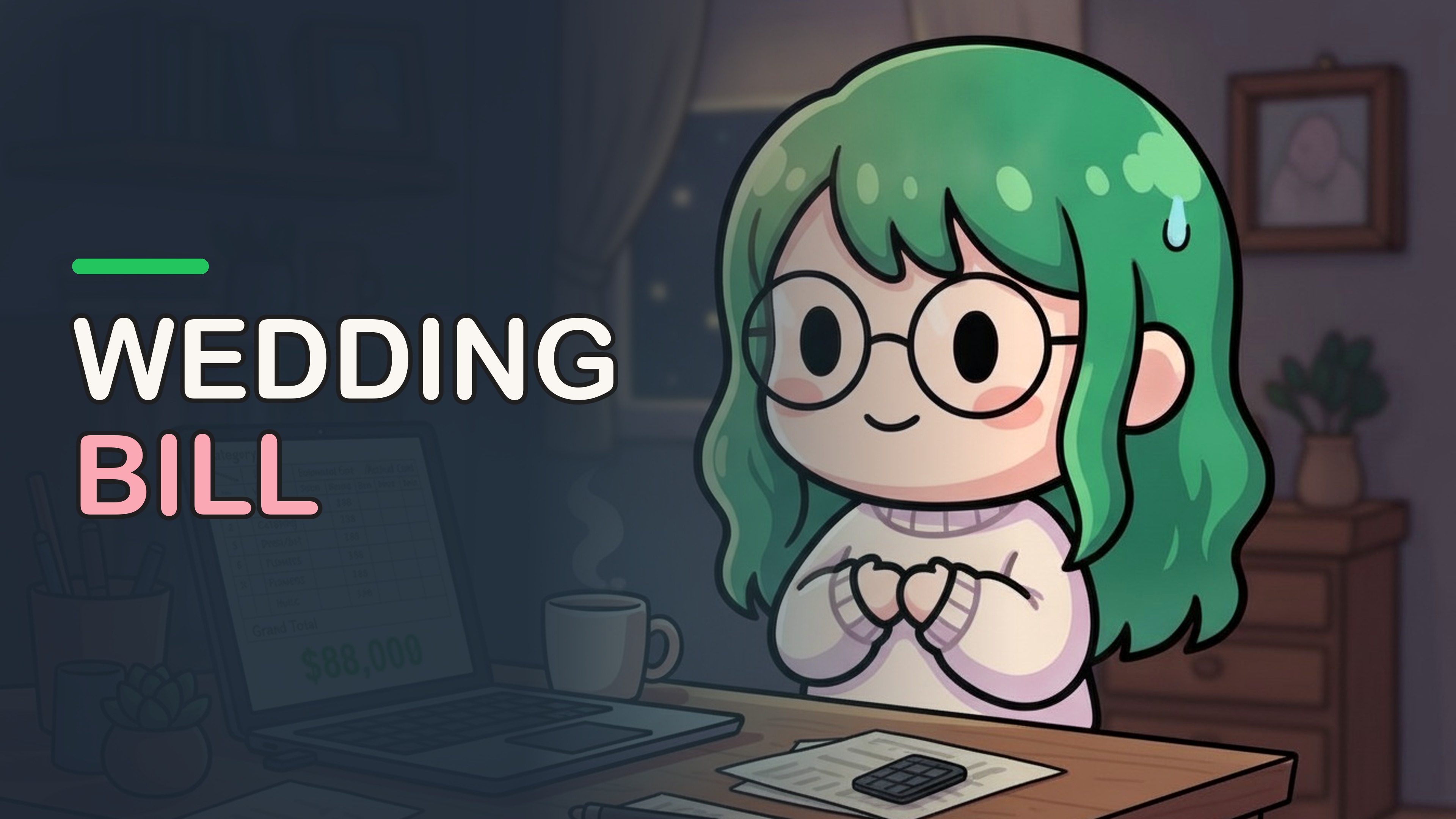
It's almost one in the morning, and you're staring at a spreadsheet again. The shared one.
The wedding lasts one day, while the payments can follow the marriage home. Status, family expectations, and vendor pricing can turn a celebration into a performance nobody feels allowed to scale down.
Transcript
Read the full transcript
It's almost one in the morning, and you're staring at a spreadsheet again. The shared one. The wedding one. You just moved a number from one cell to another, and the total at the bottom went up, and you told yourself the same thing you always tell yourself. It's fine. This is just what weddings cost now. Everybody spends this. You're not being crazy.
And maybe you started somewhere reasonable. A number you said out loud to your partner, a number that already felt like a lot. But that number was months ago. Since then it's been a slightly nicer venue, and then the good photographer, because you only get the photos, and then one more table because you couldn't not invite them, and then the flowers, and the dress, and a dozen little upgrades that each felt like nothing.
Nobody sat down and decided to spend thirty thousand dollars. You said yes to a deposit. Then you said yes to protecting the deposit. And somewhere in there it stopped being a party and started being a project with a payment plan.
If you've ever hidden the real total from yourself. If you've ever done the math in per-person terms so it sounds smaller. If there's a card statement you are not opening until after the honeymoon. This one is for you. Because this is not you being bad with money. This is a very specific psychological trap, and it has a name, and it has an exit.
So let's take the shame off the table first, because you're going to need a clear head for the fix.
You are not a bridezilla. You are not shallow. You are standing inside one of the most sophisticated pressure machines in modern consumer culture, and it is aimed directly at you.
Here's the first thing happening. It's called anchoring. Every price you see gets compared to the other wedding prices around it, not to normal life. So five hundred dollars for flowers stops sounding like five hundred dollars for flowers. It sounds like a deal, because the photo next to it was twelve hundred.
The second thing is social comparison, and it runs on your phone. Every reel, every friend's album, every styled table you scroll past quietly resets what you think a normal wedding looks like. You're not copying the most expensive wedding you saw. You're just slowly moving your idea of average toward it.
And the third thing is the deepest one. Your brain treats this as a once-in-a-lifetime day, so every cut feels like a permanent loss. Skip the good band, and it's not a band you skipped. It's a memory you'll never get back. That framing makes it almost impossible to say no. Your brain isn't trying to waste money. It's trying to protect a day it has been told it can never redo.
So here is how the trap actually closes, in six steps. See how many you recognize.
Number one. The wedding tax. Researchers ran an experiment where they asked vendors for a price on an ordinary party, and then asked for the exact same thing, but for a wedding. Same flowers. Same rental. Same date. The wedding version cost about fifty percent more. Nothing changed except one word. And when they asked brides what they'd be willing to pay, some said they would pay almost five times as much for the dress as a woman planning an identical event that wasn't a wedding. The word is a switch, and it quietly turns your price ceiling off. The exhausting part is that you can feel it happening and still not stop, because fighting every quote back down to normal is a second full-time job you don't have the energy for.
Number two. Upgrade creep at the tasting. This is where they show you the good option right after the basic one. The nicer bar. The plus-one entree. The upgraded linens. And every single one is sold to you in per-person math. It's only four dollars a head. It's only six dollars a plate. Four dollars sounds like a coffee. But you have a hundred and seventeen guests, and you are going to hear it's only four dollars a head about fifteen times, and each yes quietly adds hundreds of dollars to a total you have already stopped watching.
Number three. The deposit ratchet. The first deposit is the real trap, because the moment you pay it, downgrading starts to feel like losing money you already spent. That is called sunk cost, and the whole industry runs on it. Once you've put a thousand dollars down on the expensive venue, the cheaper venue doesn't feel like saving anymore. It feels like throwing the thousand away. So you stay. And you spend up to match the room you're now committed to.
Number four. Guest-list inflation. Every name on that list is not a name. It's a plate, a chair, a favor, and a slice of that per-person number. But you don't add guests as dollars. You add them as guilt. Your mom's friend. His coworker. The cousin you have to. And because each one feels like a relationship instead of a receipt, the list only ever grows, and nearly three hundred dollars follows every single addition. The tax you don't see is the week you lose agonizing over a seating chart for people you were pressured into inviting.
Number five. The financed forever-day. This is the one that does the real damage. When the numbers finally get scary, someone offers you a way to not feel them. A card. A zero percent plan. A wedding loan. And here is what the research actually shows about paying with credit. People who paid with a card underestimated what they had spent by almost thirty percent, and most of them couldn't even remember the number afterward. Financing doesn't just delay the cost. It erases it from your memory while you are still spending. Zero percent isn't only interest-free. It's reality-free.
Number six. The comparison feed, but now on a countdown. As the date gets closer, the scrolling gets worse, because every wedding you see is suddenly a list of things you might be missing. And here is the part that should stop you cold. When couples were surveyed during an anxious economy, the ones who changed their budget mostly didn't cut it. Seventy-seven percent of them spent more. Fear was supposed to make you careful. Instead it made you buy the whole day, faster, before the day could be taken away.
Now here's the part nobody puts on the invitation.
The whole point of this day is to launch the marriage. To start the life. And the way it's built, it can quietly do the opposite.
Because the debt doesn't end at the reception. It moves in with you. It's there in the first month, when the thank-you cards are still going out and the first payment is already due. It's in the fight you have in August about money you spent in June. It's in the house you keep not buying, because the down payment slowly turned into a dance floor.
In one survey, a third of newlyweds who owned homes said the wedding pushed back when they could buy one. Half of them shrank the wedding just to afford a better house later. And there is even research, and I want to be honest that this is a correlation and not proof, that the couples who spent the most on their weddings were more likely to divorce, not less. The bigger day did not buy the stronger marriage.
So here's the cruel version. You spent all of it to prove the love was real. But the security that actually lets love grow, the not fighting about money, the quiet cushion, the feeling that you're building something together, that is the exact thing the spending pushed further away. You performed the marriage for one night, and you financed it for three years.
So here's how you get out, and none of it requires you to become a different person or to want less.
First, fund the future before you fund the wedding. Not after. Before. One of the most powerful findings in the psychology research is something called immediacy. Money that leaves now, from real cash, hurts in a way that actually protects you. So set up an automatic transfer into your real future first. The emergency fund. The down payment. Whatever your actual next chapter is. And let the wedding have what's left. Not what's borrowed. What's left. When the future gets funded first, the wedding loses the ability to eat it.
Second, make one number, and make it a ceiling, not a floor. Write down a single total for the entire wedding. One number. And here's the rule that makes it work. Every upgrade comes out of that number. Nothing gets added to it. Want the better photographer. Great. What are you cutting to pay for it. The cap isn't a punishment. It's the thing that turns a hundred small yeses back into one honest decision.
Third, translate every price back into the truth before you say yes. The reason per-person math works on you is that it hides the total. So reverse it, out loud. It's not four dollars a head. It's five hundred dollars. It's not zero percent for a year. It's four thousand dollars I am choosing to owe. The research is blunt about this. The simple act of making yourself say the real number, and write it down, lowers how much you spend. Rehearsing the cost is the brake.
Fourth, decide your scripts before the pressure, not during it. Two sentences, written tonight, while you are calm. One for vendors. That's beautiful, and it's outside our budget. What fits inside this number. And one for family. We love you, and the guest list is closed. You will not invent those sentences in the moment, with a salesperson watching your face and your mother on the phone. So don't try. Write them now.
None of this means your wedding has to be small, or sad, or joyless. It means the day should belong to you, and not to a card statement that outlives the flowers.
The couples who look back happiest are almost never the ones who spent the most. They're the ones who woke up the next morning married, and not one dollar more behind than they actually chose to be.
So before you scroll one more feed, tell me. Which one got you. Was it the wedding tax, where a single word doubled the price. The deposit ratchet, where quitting felt like losing. The guest list you couldn't say no to. Or the financing that made the whole thing feel free, right up until it didn't.
Tell me in the comments. And if someone you love is deep in a spreadsheet right now, at one in the morning, telling themselves it's just what weddings cost, send them this before the next deposit. Because the best gift you can give a marriage is not a perfect day. It's a first year that isn't quietly on fire.
Sources & further reading
These are the research sources reviewed for this episode. Evidence and guidance can change; updated entries show a new date above.
- LendingTree, Newlywed Wedding Debt Survey (2025)— lendingtree.com
- LendingTree, Newlywed Homeowners Survey (2025)— lendingtree.com
- The Knot, Average Wedding Cost / 2026 Real Weddings Study— theknot.com
- The Knot, Average Wedding Cost / 2026 Real Weddings Study — https://www.theknot.com/content/average-wedding-cost ·— theknotww.com
- Consumer Perceptions and Pricing Practices for Weddings, Journal of Consumer Policy (2021)— d-nb.info
- Soman, Effects of Payment Mechanism on Spending Behavior, Journal of Consumer Research 27(4), 2001— www-2.rotman.utoronto.ca
- Francis-Tan & Mialon, "A Diamond is Forever and Other Fairy Tales", Economic Inquiry 53(4), 2015— onlinelibrary.wiley.com
- Francis-Tan & Mialon, "A Diamond is Forever and Other Fairy Tales", Economic Inquiry 53(4), 2015 — https://onlinelibrary.wiley.com/doi/abs/10.1111/ecin.12206 · working paper— papers.ssrn.com
- McGee (2016), critique/commentary— papers.ssrn.com
- CNBC, Newlyweds went into credit card debt for wedding (2024)— cnbc.com
- NerdWallet, Engagement ring financing— nerdwallet.com
- Her First $100K / Financial Feminist, Financial boundaries for weddings— herfirst100k.com
More in Money, Relationships & Culture
Start with your own patterns
The free Money Pattern Lab turns seven ordinary days into one clearer picture of your spending triggers.
Your PDF opens immediately. Confirm your email for the free welcome series and weekly letter. Unsubscribe whenever.